
Living in Spring Branch
Texas Real Estate Sales Agent #454749, AXEN Realty LLC · Senior Loan Officer, NMLS ID #877741, NEXA Mortgage, LLC
Local Guide & Real Estate
Spring Branch, Texas sits in western Comal County in the Texas Hill Country, along the US 281 corridor north of San Antonio. When buyers search for Spring Branch homes they almost always mean the broad 78070 area, not the tiny incorporated city that shares the name. This guide explains the difference, what the 2026 market actually looks like, how schools, water, and taxes really work here, and what to check before you buy or sell.
Patrick's Quick Answer
Last updated: October 8, 2026Spring Branch in one paragraph
Spring Branch is a mostly unincorporated Hill Country area in western Comal County along the US 281 corridor north of San Antonio, and the same name also belongs to a tiny incorporated city nearby. Buyers searching for Spring Branch homes almost always mean the broad 78070 area, where the housing mix runs from older ranch-style homes and newer subdivisions to custom acreage, gated estates, and river-adjacent properties. This guide explains the difference between the two Spring Branches and how schools, water, septic, floodplain, and taxes really work here, property by property.
The honest trade-offs are the commute into San Antonio and the parcel-level homework: water and septic, floodplain, school boundaries, and tax jurisdictions are all verified for the exact address, never by ZIP code.
County
Western Comal County
Unincorporated area in the Texas Hill Country; some 78070 addresses sit in adjacent counties at the edges.
Main roads
US 281, SH 46
FM 306 and FM 311 swing toward the Canyon Lake side of the area.
Schools
Comal ISD
Campus assignment is set by the exact address; boundaries shift as the district grows.
Market
$423,572
Comal County median sale price, Redfin, 3 months ending August 2026. No official ZIP-level figure is published.
The Most Important Fact First
There are two "Spring Branches," and most sites miss it
This is the single most useful thing to understand before you search. One Spring Branch is a tiny incorporated city. The other is the large Hill Country area buyers actually mean when they look for Spring Branch homes.
The incorporated City of Spring Branch
- Incorporated November 19, 2015, as a Type C general-law municipality under Texas law.
- Roughly 1.9 square miles in size.
- The 2020 Census counted about 206 residents.
- Its city tax rate applies only inside this small limit, to a few hundred people.
The Spring Branch / ZIP 78070 area
- What buyers usually mean by "Spring Branch homes."
- Roughly 130-plus square miles of Hill Country residential area.
- Population estimates range from the mid-teens to 20,000-plus depending on the source and year; 78070 also carries some Bulverde and Canyon Lake addresses.
- Most properties here are unincorporated Comal County and have no city property tax.
The takeaway: do not assume every address labeled "Spring Branch, TX 78070" sits inside city limits. Most of the buyer market sits outside them, and the difference matters for taxes, city services, and how the community is governed. Whenever you look at a listing, confirm the actual county and tax jurisdictions of the parcel, never the mailing label.
Source: U.S. Census Bureau, 2020 Census, for the incorporated city's population; city area and 78070 area figures are approximate and parcel-specific.
Location + Access
Where is Spring Branch, Texas?
Spring Branch is in western Comal County in the Texas Hill Country, genuinely part of the US 281 corridor. Understand the roads and the drive before you ever look at a house, because both shape daily life here.
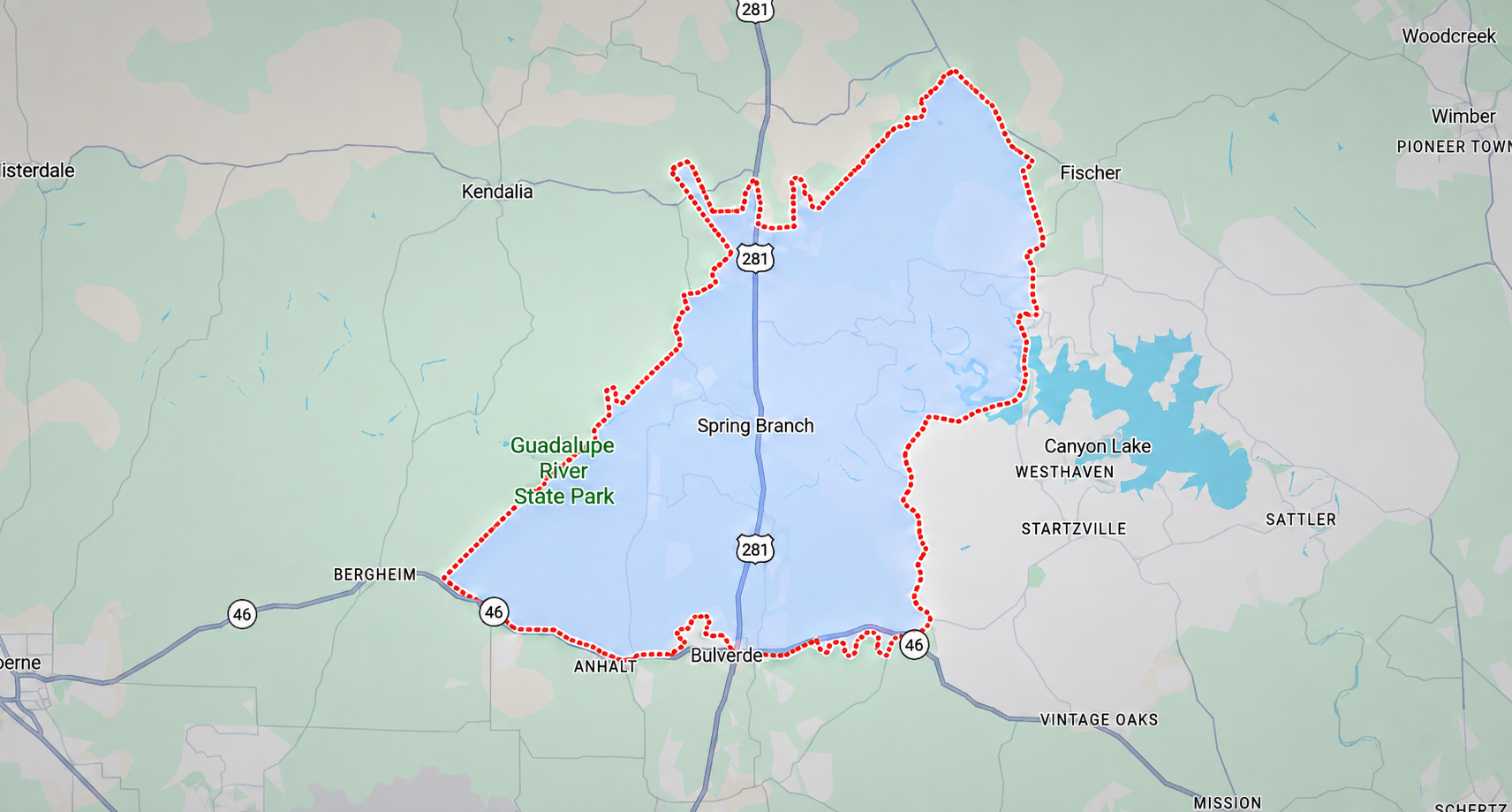
Area Map
Spring Branch / 78070 in context
The corridor runs along US 281, with Bulverde to the south, Boerne to the west across SH 46, New Braunfels to the east, and Canyon Lake to the southeast.
US 281
The north-south spine of the corridor. Head south toward Bulverde and north San Antonio, north toward Blanco and the wider Hill Country.
State Highway 46
The east-west connector: east toward New Braunfels and the I-35 corridor, west toward Boerne. Much of the local shopping and dining sits along it.
FM 306 and FM 311
The routes that swing toward Canyon Lake and the eastern side of the area, where the lake-adjacent communities sit.
Nearby anchors
Guadalupe River State Park, Honey Creek State Natural Area, Canyon Lake, Bulverde, New Braunfels, Boerne, and north San Antonio.
| Destination | Approx. route | Notes |
|---|---|---|
| Downtown San Antonio | US 281 south | Roughly 30-40 miles by road; traffic-dependent, typically 35-55 minutes. Test the drive at the time you would actually make it. |
| North San Antonio / airport area | US 281 south | The closest practical part of the metro, roughly 25-30 miles from the southern end of the corridor. |
| Bulverde | US 281 south | Roughly 5-10 miles depending on the exact home; the two areas share the 78070 ZIP. |
| Canyon Lake | FM 306 / local roads | Roughly 10-15 miles from much of the corridor, minutes from the east side of the area. |
| New Braunfels | SH 46 east | Roughly 20-25 miles, one of the area's go-to towns for shopping and dining. |
| Boerne | SH 46 west | Roughly 20-25 miles west through Hill Country ranch country. |
Every mile and minute above is approximate, route-dependent, and traffic-dependent. Mileage is math; the commute is experience, so drive it on a workday before you commit to a property.
History + Local Identity
A short history of the name
The community's roots trace to German immigration in the mid-1800s, and the settlement is commonly dated to roughly 1852. A post office was established in 1858, and the area's ranching and agricultural character shaped it for more than a century.
The name comes from a spring-fed creek that flows toward the Guadalupe River, and that same water heritage still shows up in daily life: springs, creeks, wells, and the river all matter here. History is a one-paragraph context, not the point of buying here. The point is what the area looks like today, which the rest of this guide covers.
Current Market
The Spring Branch market, dated and sourced
A short warning before the numbers: there is no single correct Spring Branch median price. Datasets disagree because the geography differs and the property mix runs from raw land to multimillion-dollar custom and waterfront homes. Below is the honest, dated picture: the county-wide figure from Redfin for the 3 months ending August 2026, labeled exactly as published, and the ZIP-level gap stated plainly. Median sale price is used throughout, never median asking price.
Median sale price (Comal County)
$423,572
+4.6% year over year, all housing types, county-wide.
Source: Redfin · 3 months ending August 2026
Median sale price per square foot (Comal County)
$205
County-wide figure, never presented as a Spring Branch town figure.
Source: Redfin · 3 months ending August 2026
Days on market (Comal County)
94
Median days on market, county-wide.
Source: Redfin · 3 months ending August 2026
Year-over-year change (Comal County)
+4.6%
Median sale price change versus the same 3-month period a year earlier.
Source: Redfin · 3 months ending August 2026
No unsourced numbers are used above. County figures are labeled county-wide and never presented as town data. Active list prices are not the same as closed-sale prices, and the median of either can move month to month. Never let one county or ZIP-wide median speak for a specific property: comps are built address by address, and Patrick pulls current listing and sales data for the exact property and price band when you work with him.
Housing + Neighborhoods
What housing actually looks like in Spring Branch
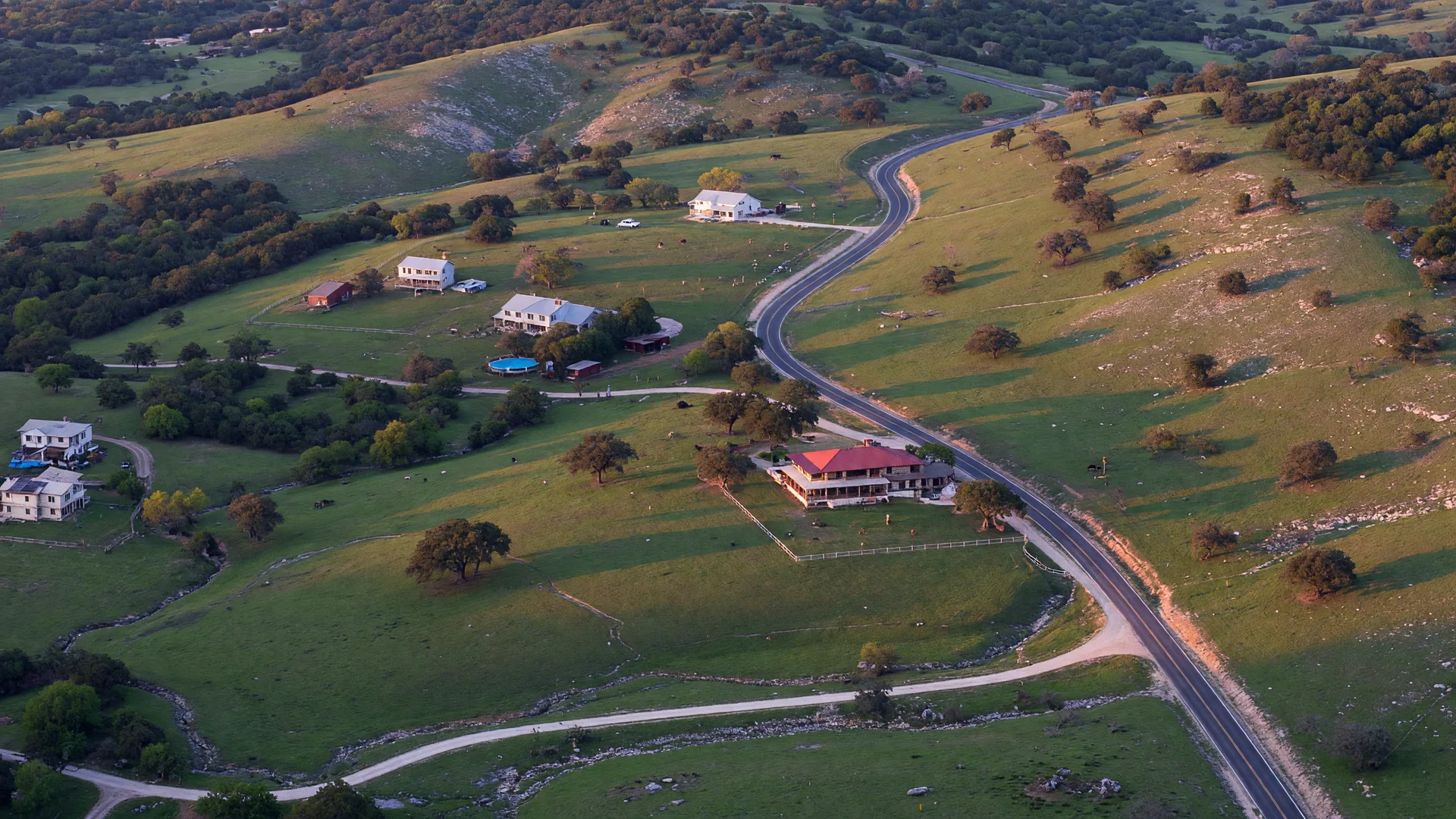
Do not picture one uniform suburb. The 78070 corridor holds traditional subdivisions, custom Hill Country homes, newer construction, older rural homes, acreage and ranchettes, vacant land, river-oriented and Canyon Lake-oriented properties, gated communities, and golf-adjacent pockets in some areas. That variety is exactly why a generic automated valuation and a single ZIP-wide median can mislead you.
01
Subdivision and master-planned homes
Managed common areas, HOA rules, and often community or municipal-style water and sewer. The monthly picture is more predictable; the HOA and a first-year new-build tax increase are part of it.
02
Custom Hill Country homes
Built to a buyer's plan on a specific lot, often with views, live oaks, and limestone. Custom builds run on longer timelines and need their own construction financing conversation.
03
Acreage, ranchettes, and vacant land
One to five or more acres is a common pattern, usually with well and septic. Vacant tracts add a buildability checklist: slope, rock, access, water, and utility reaches all get verified before you build a budget.
04
River and lake-oriented properties
Near the Guadalupe River and Canyon Lake, the premium is the setting and recreation. The diligence is parcel-specific: real water access, easements, floodplain, and insurance.
05
Gated communities and estate pockets
Gated sections sit across the corridor, from lake-adjacent estates to acreage communities. Each carries its own HOA or POA, so access rules and restrictions are verified for the exact phase and lot.
06
Older rural and ranch-style homes
Condition runs the full range, and updates may or may not have kept pace. The price has to match the actual condition and systems, plus the well, septic, and outbuilding picture.
Why Spring Branch values vary so much: valuation can change materially based on acreage, usable versus steep or rocky land, custom versus production construction, age and condition, Guadalupe River proximity and access, Canyon Lake proximity, Hill Country views, gated versus open community, golf and community amenities, outbuildings and shops, pool, septic configuration, well or community water, HOA or POA restrictions, road access, lot topography, trees, and renovation quality. One ZIP-wide estimate cannot see any of that. If you own a property here, the honest pricing tool is a property-specific market analysis, not an automated ZIP-code estimate.
| Community | Character | Lot / Setting | Who it tends to fit |
|---|---|---|---|
| Mystic Shores | Established lake-adjacent community near Canyon Lake, with neighborhood lots plus custom and estate sections. | Mix of managed lots and larger estate sites; gated sections carry HOA context. | Buyers who want lake-adjacent Hill Country living with an established community feel. |
| River Crossing | Custom-home community in the Spring Branch area with club amenities; wildlife is part of the setting. | Community lots set up for custom construction. | Buyers planning a custom build on a community lot with resort-style amenities. |
| Rivermont | Established residential community with an HOA and private Guadalupe River access at River Park, plus pools, sports courts, and trails. | Single-family lots with community amenities and river access. | Families who want community amenities plus real river access without buying a riverfront lot. |
| Serenity Oaks | GG Gale land and custom-home development on the river side of the area, with 1 to 3 acre Hill Country lots, gated entry, and paved roads. | One to three acre lots with private river access. | Buyers who want acreage plus river proximity and plan to build custom. |
| Juniper Ranch | Lennar master-planned community with multiple collections, community center, pool, fitness, and parks. | Newer subdivision lots with managed common areas. | Buyers who want a brand-new home in a managed community with newer amenities. |
| Kestrel Air Park | Private gated residential airpark with aviation-oriented homes and hangar properties. | Acreage lots with attached hangars and runway access. | Pilots and aviation-minded buyers; a genuinely rare Spring Branch niche. |
Community names, builders, HOA rules, and phase details change as sections launch and sell through, so verify what is active today for the exact lot or phase you are considering. If you are comparing corridors, stack Spring Branch against Bulverde, Smithson Valley, and the wider Texas Hill Country guides side by side before you narrow the search.
A Spring Branch Original
Kestrel Air Park: fly-in living in the Hill Country
Kestrel Air Park is a private, gated residential airpark community in the 78070 area, developed starting in the late 1990s off US 281. It holds roughly 95 to 100 homes, mostly on acreage, and many properties include attached private hangars for aviation owners.
The community owns and maintains a roughly 3,000-foot asphalt runway with lighting, and aviation-oriented homeowners make up the character of the place. Runway rules, HOA requirements, and current inventory are all specifics you verify against the community and the property before buying: airpark living is a niche where the fine print matters, from hangar use to taxiway access.
It is unusual, specific content that sets Spring Branch apart from any generic Hill Country guide, and it is one more reason the 78070 market refuses to behave like a single neighborhood.
Schools
Spring Branch schools: Comal ISD, address by address
The Spring Branch area is primarily served by Comal ISD, a large and rapidly growing district with reported enrollment above 30,000 students in recent years. The honest rule: the campus your home feeds is set by the exact address, not by the neighborhood name.
Campuses in or strongly associated with the 78070 area
- Arlon R. Seay Elementary
- Bill Brown Elementary
- Rebecca Creek Elementary
- Spring Branch Middle School
- Smithson Valley Middle School
- Smithson Valley High School
Verify the boundary, not the mailing label
Comal ISD's attendance boundaries shift as the district grows, and rezoning happens: families currently riding to one campus can be reassigned to a new one. I will never promise that a Spring Branch mailing address attends a particular school. Before you rely on an assignment, verify the exact property address with the district's current attendance-zone tools, and ask what boundary changes are already on the books for the years ahead.
The school-zone complexity is itself useful buyer knowledge: it affects resale value, your daily routine, and the school commute, so verify the assignment while you can still act on the answer. How school boundaries work for buyers is answered in plain language in the Ask Patrick library.
State accountability ratings change year to year and are published per campus, so if ratings matter to you, check the Texas Education Agency's current year results for the specific campus rather than relying on a neighborhood label.
Water + Utilities
Wells, septic, and utilities: the parcel-by-parcel reality
There is no one uniform utility setup across the 78070 area, and claiming otherwise would be wrong. Depending on the exact property, buyers may find a private well, community water, septic or OSSF, different electric providers, different internet providers, and private trash service, often all within a mile apart. The only way to know your property's answer is to verify the specific parcel.
Providers that show up here
Who serves parts of the area
Pedernales Electric Cooperative (PEC) provides electric service in the Spring Branch area with a district office on SH 46. GVTC provides phone, internet, and cable in parts of the corridor. Texas Water Company is the water utility for the incorporated city and serves parts of the wider area. Comal Trinity Groundwater Conservation District, based in Spring Branch, regulates groundwater use in Comal County. None of these is a guarantee for a given parcel; each is verified by address.
The buyer questions that matter
Run this list on every property
- Is this house on a private well, or community water?
- What type and age is the septic system, and when was it last serviced?
- Is there enough usable land for future improvements?
- Are there groundwater restrictions for the parcel?
- What internet is actually available at this address?
- Who maintains the road, and is trash service private?
- Are there utility easements that limit what you can build?
Well and septic change the checklist, not the decision. On acreage, water source and sewer type are part of the diligence, not a dealbreaker. A well means yield, water quality, and pump condition checks; a septic system means age, capacity, and drain-field checks. Power, water, and septic reports are normal parts of buying a rural property, and I walk buyers through each one before we write an offer. Wells and septic on Hill Country homes covers the details, and what to ask about a well and what to ask about a septic system are answered in the Ask Patrick library.
Hill Country Infrastructure
Water, septic, aquifer, floodplain, and burn bans: checked recently
Spring Branch is unincorporated Hill Country country, which means the water story is never one answer. Below is the current, dated status for each infrastructure item that matters when you buy: water provider, private wells, septic, aquifer stage, floodplain, and burn bans. Each line carries an official source and the date it was last checked.
Water provider: it depends on the parcel
Texas Water Company serves the incorporated City of Spring Branch and much of the US 281 and SH 46 growth corridor. Elsewhere in 78070, water supply corporations such as Spring Branch Indian Hills Estates WSC and Cypress Cove WSC, Rebecca Creek MUD, and private wells serve different pockets. The provider for a given property is verified by address.
Private wells on rural tracts
Rural and larger-acreage Spring Branch properties commonly rely on private wells drawing from the Trinity Aquifer, which is regulated in Comal County by the Comal Trinity Groundwater Conservation District. Well yield, water quality, and pump condition become part of the buyer's inspection list on those properties.
Septic and OSSF systems
On-site septic is common on Spring Branch acreage and older homes, while community or municipal-style sewer serves many established subdivisions and newer communities. Age, capacity, and drain-field condition come from the property's own records and a licensed inspection, never from a ZIP-level rule.
Aquifer stage and spring flow
Spring Branch groundwater comes from the Trinity Aquifer, not the Edwards Aquifer recharge zone, which lies well to the southeast. As a regional water indicator, the Edwards Aquifer Authority reported the San Antonio index well near 638 feet and Comal Springs flow near 143 to 159 cubic feet per second in late September 2026.
Floodplain: parcel-specific
The FEMA Flood Insurance Rate Map and Comal County floodplain records are the official check for an address. Proximity to the Guadalupe River does not automatically mean flood-zone status, and being away from the water does not guarantee clean drainage in flash-flood country.
Burn ban status
As of October 7, 2026, there is no active burn ban in Comal County or Kendall County. Comal lifted its August 2026 ban in early October and Kendall lifted its ban on October 2, 2026. Status changes quickly with drought conditions, so confirm before any outdoor burning.
Every item above was last verified on October 7, 2026, and daily conditions (spring flow, burn bans, road status) change frequently. Always confirm the current status with the listed official source for the exact parcel you are considering.
Property Taxes
Spring Branch property taxes: there is no single rate
Property taxes in Texas are the sum of separate taxing jurisdictions, each levying its own rate per $100 of taxable value, and the stack varies by exact parcel. That is the honest answer for Spring Branch, and the tiny incorporated city and the broader 78070 area are not interchangeable for taxation.
| Jurisdiction | Tax year | Adopted rate | How it applies |
|---|---|---|---|
| Comal County | Tax year 2025 | About $0.305 per $100 valuation | The county line in the stack for taxable property in Comal County, adopted with the FY 2026 budget. |
| Comal ISD | Tax year 2025 | About $1.0748 per $100 valuation | Maintenance and operations plus debt service combined; applies where the property sits in Comal ISD, which covers most of the 78070 market. |
| City of Spring Branch | Parcel-specific | Applies only inside city limits | The city tax applies only inside the tiny incorporated area; most 78070 buyer market sits outside city limits and has no city property tax. |
| ESDs and special districts | Parcel-specific | Parcel-specific | Emergency services districts fund fire and EMS in parts of the Bulverde and Spring Branch area; road and special districts vary by parcel. |
Rates shown are the adopted tax year 2025 figures from the official taxing authorities and are subject to change annually. Total rate always depends on the exact parcels' jurisdictions.
What the stack adds up to: for a typical unincorporated 78070 property, the two main lines above, Comal County plus Comal ISD, add up to roughly 1.4% of value per year before exemptions and before any ESD or special district adds its share. It is a planning range, not a quote: buyers must verify the exact jurisdictions and rates for the specific parcel through the Comal Central Appraisal District (Comal CAD) and the applicable taxing authorities. Taxable value is the assessed value after exemptions, and a Texas homestead exemption has to be filed to apply. How property taxes vary by district and the Bulverde and Spring Branch tax picture explain more.
What It Costs to Buy Here
What it costs to buy a home in Spring Branch
Four numbers anchor the buying budget here: the property tax rate, the insurance range, HOA or POA dues, and what down payment assistance can do. No interest rates, loan payments, or APRs appear on this page on purpose. Every figure below shows its value, label, source, and period, and the one number that cannot be verified is stated as a gap rather than guessed.
Property tax rate
Comal County's adopted rate is $0.305015 per $100 of taxable value and Comal ISD's is $1.0748 per $100 (tax year 2025), a combined planning range of roughly 1.38% of value before exemptions and any special district share. Most 78070 parcels sit outside city limits, so most carry no city property tax. The exact stack is verified per parcel with the Comal Central Appraisal District.
Source: Comal County Tax Rates; Comal ISDHome insurance
The Texas Department of Insurance reported an average Texas homeowners premium of $3,291 in 2024 (preliminary $3,489 in 2025). River-adjacent and acreage properties can differ significantly, so get a dated quote for the exact property before budgeting.
Source: Texas Department of InsuranceHOA and POA dues
Gap: no official source publishes a single HOA range across Spring Branch, because dues are set community by community and vary widely between subdivisions, gated river communities, and open acreage tracts. The exact assessment comes from the property's HOA or POA documents before an offer.
Source: Verify per communityDown payment assistance
Texas buyers can access state programs such as the TDHCA Texas Homebuyer Program (down payment and closing cost assistance up to 5% of the loan) and TSAHC Home Sweet Texas and Homes for Texas Heroes (3% to 5% assistance) for eligible buyers and price ranges. Eligibility is income- and purchase-price-based and changes, so verify current program terms at application.
Source: TDHCA; Texas State Affordable Housing CorporationPlan the cash you bring to closing
Use Patrick's cash-to-close calculator to add up typical closing costs for a Spring Branch purchase, then talk to him about down payment assistance and seller concessions that can lower the total.
Tax rates are adopted annual figures and change each budget cycle. Insurance premiums are state averages, not quotes for a specific river or acreage property. Down payment assistance eligibility is income- and purchase-price-based and program terms change, so verify the current rules at application.
Acreage Due Diligence
Buying acreage or land in Spring Branch: the due-diligence list
Five acres never automatically means five usable acres. Here is the checklist I run through with buyers on any tract, because each line can change what the land is worth and what you can actually do with it.
Survey and legal description
Legal access to the property
Easements across the tract
Road maintenance responsibility
Deed restrictions and covenants
HOA or POA status
Buildability of the lot
Slope and topography
Rock and soil conditions
Drainage patterns
Floodplain status
Water source for the home
Well feasibility and yield
Septic or OSSF feasibility
Electric availability and cost to reach
Internet and phone availability
Livestock and horse restrictions
Minimum home size requirements
Architectural controls
Outbuilding and shop rules
Utility extension and tap costs
The two rules I repeat most
"5 acres" is a count of land, not a count of usable land. Steep, rocky, floodplain, or easement-laden ground can shrink the buildable area fast, so verify the buildable envelope before you price the land.
Do not assume livestock or horses are permitted just because a property has acreage. Deed restrictions and HOA rules decide that, and they vary lot to lot across the corridor.
Deeper reading: buying a home with acreage in Spring Branch walks the acreage purchase step by step, and whether you need a survey when buying in Texas answers the first line of this list.
River + Parks
The Guadalupe River, floodplain, and the outdoors
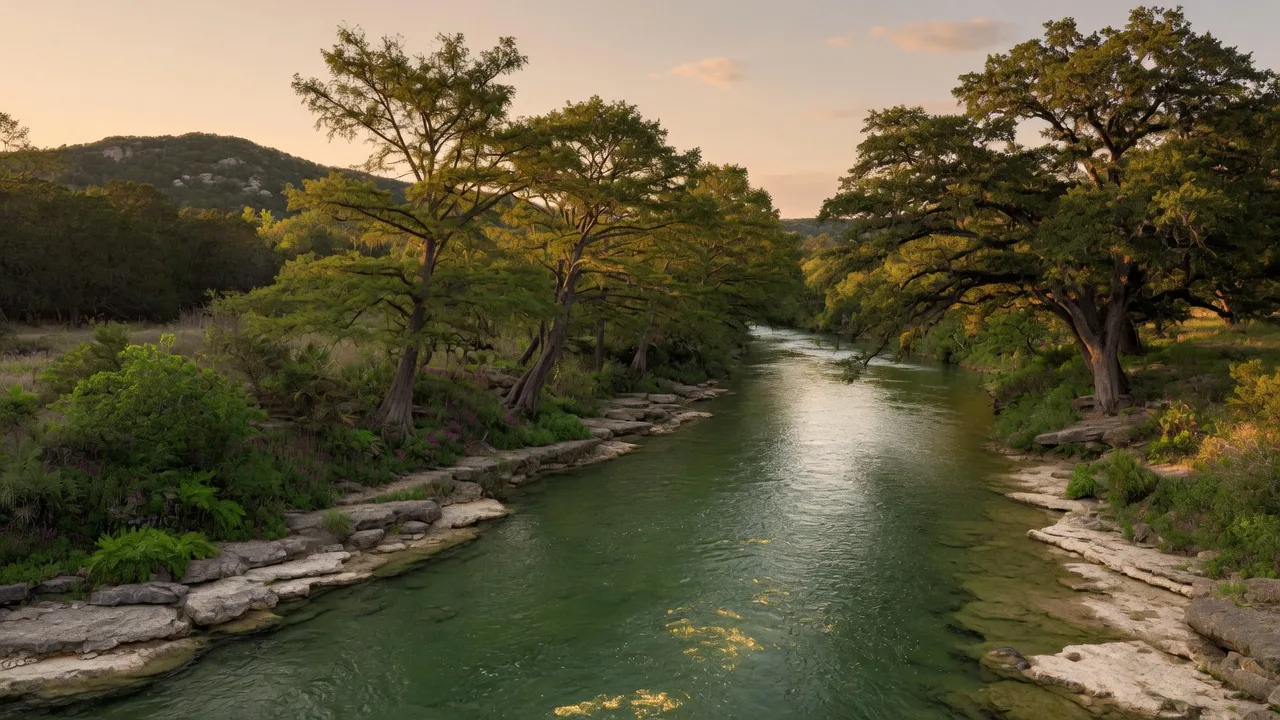
Spring Branch has meaningful Guadalupe River proximity, and that shapes both the lifestyle and the diligence. Three distinctions keep buyers out of trouble: river proximity is not private frontage, community river access is not deeded individual frontage, and the floodplain is checked property by property.
River access, honestly explained
Public access points such as Nichols Landing, a Comal County park on the west side of the area, put paddlers and swimmers on the river, and the TPWD-certified Nichols Landing Paddling Trail runs downstream from there. On private property, access, easements, and restrictions must be verified for the exact parcel, and access rules can change, so verify legal access before you pay a river premium.
Flood risk is parcel-specific
Check the FEMA Flood Insurance Rate Map for the exact parcel, and check Comal County GIS and floodplain records. Proximity to the river does not automatically mean flood-zone status, and being away from the water does not guarantee clean drainage in Hill Country flash-flood country. Flood zones for Texas buyers, explained walks the map-reading step by step.
Guadalupe River State Park
Per Texas Parks and Wildlife, the park holds roughly 4 miles of Guadalupe River frontage, 13-plus miles of trails, camping, and paddling and fishing access, with an entry fee structure set by Texas Parks and Wildlife and daily gate hours. Check current park alerts before you go: flood closures and burn bans have both occurred in 2026, and operating details change.
Honey Creek State Natural Area
From its guided-tour heritage to a newer self-guided trailhead, Honey Creek protects one of the most pristine spring-fed creek systems in the Hill Country. Access is managed by reservation through Texas Parks and Wildlife, and the natural area is administered alongside Guadalupe River State Park.
Dog walks and daily outdoors
For trails and river scenery, the state park is the strongest public option in the area, and dog-friendly outdoor recreation there is subject to current park and leash rules. Do not assume every Spring Branch subdivision has sidewalks or its own trail system: walkability varies considerably from one neighborhood to the next, so ask what the specific community actually offers. Canyon Lake adds boating and fishing minutes away, and it gets its own full look in the Canyon Lake guide.
Food + Family Life
Where locals actually go for coffee and a meal
A small, genuinely local list is more useful than a directory dump. These are current local favorites in the Spring Branch area, each verified operating as of this writing. Businesses change hours, menus, and even ownership, so confirm current details before you plan a trip.
The Loft Coffee House
A nonprofit coffeehouse on the US 281 corridor known for its community and community-mission character: coffee, a porch, and a place to gather.
The Desert Spoon Restaurant, Coffee Bar & Bakery
Farm-to-table dining and baking inside Spring Creek Gardens on US 281, a favorite stop for breakfast through dinner.
Richter's Antler Cafe
A longtime Spring Branch cafe just off Highway 46 known for hearty plates; a reliable locals' spot rather than a chain experience.
The Branch Neighborhood Grill
A family-friendly neighborhood grill on Highway 46 with a large patio and a kids' play area, which makes it a genuine kid-and-dog Sunday answer, not a brochure phrase.
Max's Roadhouse
A casual sports pub on US 281 for burgers, wings, and an easy night out without driving into town.
Family life beyond the table
The outdoor family recreation center of the area is Guadalupe River State Park, and Canyon Lake adds swimming and boating minutes away. The area works best for families who want the outdoors, not a packed urban amenity calendar.
Why I keep this list short: restaurants open and close, and a stale recommendation is worse than no recommendation. If a specific spot matters to your decision, we confirm it is open and current before you drive out. For now, these are the places locals consistently name.
Events + Weekend Life
Local events and traditions around Spring Branch
The event calendar here runs on recurring traditions more than one-off attractions, and the best of them are worth planning a weekend around. Dates below are confirmed for 2026 as of this writing and change yearly, so check official pages before you go.
Twin Sisters Dance Hall and the Raise the Roof Cook-Off & Festival
About 10 miles north, the historic Twin Sisters Dance Hall in Blanco keeps Hill Country dance hall culture alive with live-band dances the first Saturday of most months. Its annual Raise the Roof Cook-Off and Festival, an 11th annual edition running September 25-26, 2026, is a weekend of cook-off, music, and small-town fundraising. It sits outside Spring Branch proper, so frame it as part of the surrounding Hill Country culture.
Market days
Spring Branch Canyon Lake Market Days rotates through locations in Spring Branch and Canyon Lake on a recurring schedule, and Bulverde Market Days runs the second and fourth Saturday of each month at Bulverde Village. Markets move with the season, so check the official schedule for the next date and location.
A Saturday in Spring Branch
Someone relocating here might start the day with coffee on the porch at The Loft Coffee House on US 281, spend the morning hiking a trail at Guadalupe River State Park or checking Honey Creek, grab lunch at Richter's Antler Cafe or The Branch Neighborhood Grill with the kids, spend the afternoon on the river or at a market, and finish the day at a live-music dance hall. The rhythm is outdoors by day and small-town gathering by night, which is exactly the life many buyers say they came for.
Event dates, venues, and organizers change year to year, and this page is updated when events pass. Before you travel for any event, confirm the official 2026 details on the organizer's own pages.
For Sellers
Selling a home or acreage in Spring Branch in 2026
The 2026 Spring Branch market rewards sellers who price honestly, which sounds like a cliché until you see the data: inventory is up, buyers have more options, and overpricing simply extends days on market. Pricing a Spring Branch home starts with the specific property: which of the two Spring Branches buyers mean, the river or acreage tract, Comal ISD for the exact address, and what comparable 78070 sales actually closed for.
01
Inventory is up; pricing is the strategy
Buyers have substantially more 78070 listings to choose from than a year ago. The first showing weekend is where a well-priced home wins; the overpriced one quietly loses momentum and sells for less later.
02
Acreage and custom homes need better comps
Automated valuation models lean on ZIP averages and struggle with acreage, custom construction, river access, and outbuildings. A property-specific pricing analysis built from the actual subdivision, acreage, condition, and current competition is the honest tool.
03
Condition and concessions matter more
With more choices, buyers compare condition and nitpick. Fresh paint, clean systems, a documented well and septic service history, and reasonable concessions all close the gap faster than a price cut later.
04
New construction competes in some bands
In certain price ranges, active new construction with builder incentives competes directly with resale. We price knowing exactly what a buyer could build or buy brand new nearby instead.
What I review before pricing
Pricing a Spring Branch home starts with comps that fit
- Recent closed sales in the same subdivision or micro-area, never the whole ZIP
- Active and pending competition: what buyers can buy instead of your home
- Lot size, usable acreage, views, and topography
- Age, condition, renovations, and permit history
- HOA, city jurisdiction, and taxing districts for the exact parcel
- The two Spring Branches: the 78070 market versus the 78063 town, and which one buyers mean
- River, well, and septic specifics plus Comal ISD attendance for the exact address
What buyers compare
The checklist most Spring Branch buyers run
- Guadalupe River access and acreage
- Comal ISD by exact address
- Septic and well records and floodplain
- Gated communities versus open acreage
The price starts with the specific property: the exact subdivision or tract, its condition, and what buyers can actually buy right now. I build that analysis property by property, then show you the seller net sheet so you know what you walk away with. No automated ZIP estimate and no pressure.
What I offer sellers
A property-specific pricing analysis based on the actual subdivision, acreage, condition, and current competition; a seller net sheet so you know what you walk away with; and a strategy consultation on timing, concessions, and preparation. No automated ZIP-code estimate, no pressure, just the honest positioning that gets a custom or acreage property sold. The pricing-your-home guide, the complete seller guide, and what to do when a home is not selling dig into the mechanics.
Financing Spring Branch, the honest version
- Rural and acreage financing can differ from standard tract homes, and wells and septic can create loan and appraisal requirements.
- Some addresses may qualify for USDA financing depending on current USDA maps and income limits; qualifying is verified for the exact address, never assumed.
- Higher-end custom homes can move into jumbo territory, which changes the loan conversation.
These are the checkpoints, not promises. Because I work both sides of the table, a buyer can evaluate the property and the financing in one conversation. The mortgage financing guide and USDA zero-down loans in the Hill Country cover the program details.
One roof for the mortgage and the home
I am a mortgage loan officer with NEXA Lending and a Texas real estate sales agent with AXEN Realty LLC, and I have spent more than two decades in loan origination plus years in real estate sales. In Spring Branch, where every property brings its own water, septic, tax, and appraisal story, structuring the purchase and the loan together is a genuine advantage for buyers who want the whole picture before they commit.
FAQ
Spring Branch, Texas: common questions, straight answers
Spring Branch is a mostly unincorporated area in western Comal County, Texas, along the US 281 corridor roughly 20 miles north of San Antonio, and the name also belongs to a small incorporated city nearby. Most homes listed as Spring Branch sit in the 78070 ZIP, which also carries some Bulverde and Canyon Lake addresses. The county and tax jurisdictions that apply to a parcel are set by the exact property, not by the mailing label, so verify each address.
What should I know about Spring Branch?The name Spring Branch refers to two different things: a small incorporated city of about 1.9 square miles with roughly 206 residents per the 2020 Census, incorporated in 2015, and the much larger unincorporated 78070 area where most Spring Branch listings actually sit. The broader 78070 area spans more than 130 square miles of mostly unincorporated Hill Country land where the buyer market lives. A city property tax applies only inside the small city limits, while most 78070 parcels have no city property tax.
Source: U.S. Census Bureau, 2020 Census, for the city population; area figures are approximate and parcel-specific.
Living in Spring Branch means space, Hill Country scenery, acreage, and real river and lake access minutes away, with a quieter pace and a car-dependent routine. Homes range from older ranch-style houses and newer subdivisions to custom acreage, gated estates, and river-adjacent properties, so the daily feel depends heavily on the exact neighborhood. The commute into San Antonio is real, and water, septic, flood, and school details are all verified property by property.
Hill Country communities near San AntonioThe verified figure is county-wide: Comal County's median sale price was $423,572 for the 3 months ending August 2026, per Redfin, up 4.6% year over year. No official source publishes a single median sold price for ZIP 78070, so this guide does not quote one for Spring Branch itself, and third-party ZIP-level trackers are not official figures. Ask Patrick for current data on the exact address you are considering.
Source: Redfin, Comal County housing market, 3 months ending August 2026. No official ZIP-level figure is published.
What is the San Antonio real estate market like?Comal ISD serves most of the Spring Branch area, and the campus a home attends is assigned by exact address, not by ZIP code. Campuses commonly associated with the 78070 area include Arlon R. Seay, Bill Brown, and Rebecca Creek elementary schools, Spring Branch and Smithson Valley middle schools, and Smithson Valley High School. Attendance boundaries shift as the district grows, so verify the current assignment with the district for the exact property.
How school boundaries work for buyersIt depends on the property: many acreage and older Spring Branch homes have private wells and on-site septic, while established subdivisions and newer communities often have community or municipal-style water and sewer. Texas Water Company serves the incorporated city and much of the US 281 and SH 46 corridor, while water supply corporations, a MUD, and private wells serve other parts of 78070. Confirm the actual water and sewer setup for the exact address before making an offer.
Source: City of Spring Branch utilities page and Texas PUC water utility records, checked October 2026.
How the Edwards Aquifer recharge zone worksYes, Spring Branch sits with the Guadalupe River running through and near the area, and Canyon Lake lies minutes away on the east side via FM 306 and local roads, with part of the 78070 ZIP lake-adjacent. Guadalupe River State Park is the main public front door to the river. River proximity does not mean private frontage or flood-zone status, so verify legal access and the floodplain for the exact parcel.
Source: FEMA Flood Insurance Rate Map for the exact parcel.
How to check if a home is in a flood zoneAs of October 7, 2026, there is no active burn ban in Comal County or Kendall County: Comal lifted its most recent ban in early October 2026 and Kendall lifted its ban on October 2, 2026. Burn bans change quickly with drought conditions, so confirm the current status with the county fire marshal or the Texas A&M Forest Service burn ban map before any outdoor burning.
Source: Comal County Alert Center and Kendall County Alert Center, checked October 7, 2026; Texas A&M Forest Service burn ban map.
Nearby Areas
Compare Spring Branch with nearby communities
Bulverde
Retail-friendly neighbor south on US 281, sharing the 78070 ZIP
Smithson Valley
Comal ISD high school and middle school community up the corridor
Canyon Lake
Lake recreation minutes from Spring Branch's east side
Mystic Shores
Lake-adjacent community within the broader Spring Branch market
New Braunfels
River town and regional shopping hub east on SH 46
Texas Hill Country
The wider region Spring Branch belongs to
Your Spring Branch Agent
Hire a Spring Branch REALTOR
Buying or selling in Spring Branch, with one person on your side
I am Patrick Kevin Fagan, a Texas real estate sales agent with AXEN Realty LLC and a mortgage loan officer with NEXA Lending. In Spring Branch, where water, septic, floodplain, taxes, and Comal ISD boundaries are all parcel-specific, having the home search and the financing under one roof saves you time and protects your cash to close.
What to expect when you work with Patrick
- Local market knowledge of Spring Branch, the 78070 corridor, and nearby communities
- Structured offers that pair the purchase with financing to minimize your cash to close
- Clear, patient guidance through offers, inspections, negotiations, appraisals, and closing
Texas Real Estate Sales Agent #454749 with AXEN Realty LLC. Serving Spring Branch, Bulverde, Canyon Lake, and the surrounding Hill Country.
Ready to evaluate a Spring Branch property?
If you are buying
Thinking about buying in Spring Branch? Send me the address. I can help you evaluate the property, the neighborhood, the acreage and utilities, and the financing before you make an offer.
If you are selling
Own a home or acreage property in Spring Branch? I can give you a property-specific pricing analysis based on the actual subdivision, acreage, condition, and current competition, plus a seller net sheet.


Patrick Kevin Fagan | Loan Officer and Realtor | 210-317-6514 | pfagan@nexalending.com | TX Sales Agent License 454749
NEXA Lending and AXEN Realty LLC. Equal Housing Opportunity.
Comparing Areas From California?
The California-to-Texas guide compares destinations here by total cost picture, taxes, insurance, and property-level diligence.

About Patrick Kevin Fagan, REALTOR®
Dual-licensed: Texas Real Estate Sales Agent and Senior Loan Officer
Patrick Kevin Fagan is a Texas Real Estate Sales Agent (#454749) with AXEN Realty LLC and a Senior Loan Officer (NMLS ID #877741) with NEXA Mortgage, LLC (NMLS #1660690). He brings 23+ years in mortgage lending and 19 years in real estate, serving buyers, sellers, and homeowners across Greater San Antonio and the Texas Hill Country. Buying in Spring Branch is a property-by-property process, and Patrick helps with both the home search and the financing under one roof.
Patrick Kevin Fagan, NMLS 877741 | NEXA Mortgage, LLC dba NEXA Lending, NMLS 1660690 | NMLS Consumer Access
Texas Real Estate Sales Agent #454749, AXEN Realty LLC
1399 Frontier Dr, Spring Branch, TX 78070
Equal Housing Opportunity
About Patrick Kevin Fagan, REALTOR®
Patrick Kevin Fagan is a Texas Real Estate Sales Agent (#454749) with AXEN Realty LLC and a Senior Loan Officer (NMLS ID #877741) with NEXA Mortgage, LLC (NMLS #1660690). He brings 23+ years in mortgage lending and 19 years in real estate, serving homebuyers, homeowners, and sellers across Greater San Antonio and the Texas Hill Country.
Full credentials on the About page
Patrick Kevin Fagan, NMLS 877741 | NEXA Mortgage, LLC dba NEXA Lending, NMLS 1660690 | NMLS Consumer Access
Texas Real Estate Sales Agent #454749, AXEN Realty LLC
1399 Frontier Dr, Spring Branch, TX 78070
Equal Housing Opportunity
Sources
Where the market figures on this page come from
Every market figure on this page is from Redfin, for the 3 months ending August 2026, labeled with the exact area. Each source below was accessed on October 8, 2026.
- 1
Redfin, Comal County housing market
https://www.redfin.com/county/2685/TX/Comal-County/housing-market
Accessed October 8, 2026
- 2
Redfin, Boerne housing market
https://www.redfin.com/city/2371/TX/Boerne/housing-market
Accessed October 8, 2026
- 3
Redfin, New Braunfels housing market
https://www.redfin.com/city/13081/TX/New-Braunfels/housing-market
Accessed October 8, 2026
- 4
Redfin, Canyon Lake housing market
https://www.redfin.com/city/21890/TX/Canyon-Lake/housing-market
Accessed October 8, 2026
- 5
Redfin, San Antonio housing market
https://www.redfin.com/city/16657/TX/San-Antonio/housing-market
Accessed October 8, 2026