

Quick Answer
FHA is often useful for smaller down payments, conventional can suit stronger credit, and VA is often strongest for eligible veterans. The best option depends on the complete payment and cash-to-close comparison.
Get help comparing your loan options side by side.
FHA vs conventional vs VA, which is best?
These are not four brand names fighting for your business. They are four different federal mortgage programs, each with its own entry requirements, its own money trade-offs, and its own moment where it wins. "Best" is just the one that fits your credit, your cash, your income, and the house you are buying. So let us take them one at a time, the way I walk a buyer through them at the kitchen table, and then run the real numbers on the same Texas house.
FHA: the loan most Texas first-time buyers start with
What it is: FHA stands for Federal Housing Administration, and the FHA insures the loan, which is a fancy way of saying the lender can take more risk on you: less money down, lower credit, more debt on your plate than a conventional loan will normally allow.
Entry requirements: The FHA program can require as little as 3.5% down, and a minimum decision credit score of 580 permits maximum financing. Scores from 500 through 579 are limited to a maximum 90% loan-to-value ratio, meaning those buyers still need roughly 10% down. [1] hud.gov On a $300,000 house, 3.5% down is $10,500.
The money trade-offs: FHA mortgage insurance applies under FHA rules, and that is the cost most buyers under-estimate. You pay it as an upfront premium and again every month. With a low down payment, that monthly premium generally stays for the life of the loan unless you sell or refinance, so the low entry ticket comes with a permanent monthly passenger.
When it wins: FHA wins when your credit is below conventional territory, when you have less cash saved, or when you want to pair the loan with Texas down payment assistance, because most Texas DPA plugs into FHA financing.
Conventional: the fallback that becomes the finish line
What it is: Conventional financing is not insured or guaranteed by FHA, USDA, or VA. It runs on the rulebooks of Fannie Mae and Freddie Mac, the two companies that buy most of these loans, and the lender sets the pricing. Fannie Mae says conventional loans can require as little as 3% down. [2] Fannie Mae
Entry requirements: Most conventional programs want a 620 or better credit score at the low down-payment tiers, and they price your rate by your credit tier, so a stronger score pays a lower rate. The full 3% down is realistic for a borrower with a clean file.
The money trade-offs: PMI, private mortgage insurance, is usually required when the down payment is below 20%. [2] Fannie Mae Here is the difference that matters: conventional PMI drops off once you hit 20% equity, and on many loans it terminates on its own around 78% loan-to-value. That is a permanent exit that FHA insurance does not give you.
When it wins: Conventional wins when your credit is strong and your plan is to stay in the home long enough for that PMI to come off. It is also the ticket to Texas DPA again, since programs like TDHCA My Choice Texas Home include conventional options alongside FHA, VA, and USDA. [4] MCTH_Program_Matrix
VA: the no-down, no-PMI benefit for those who served
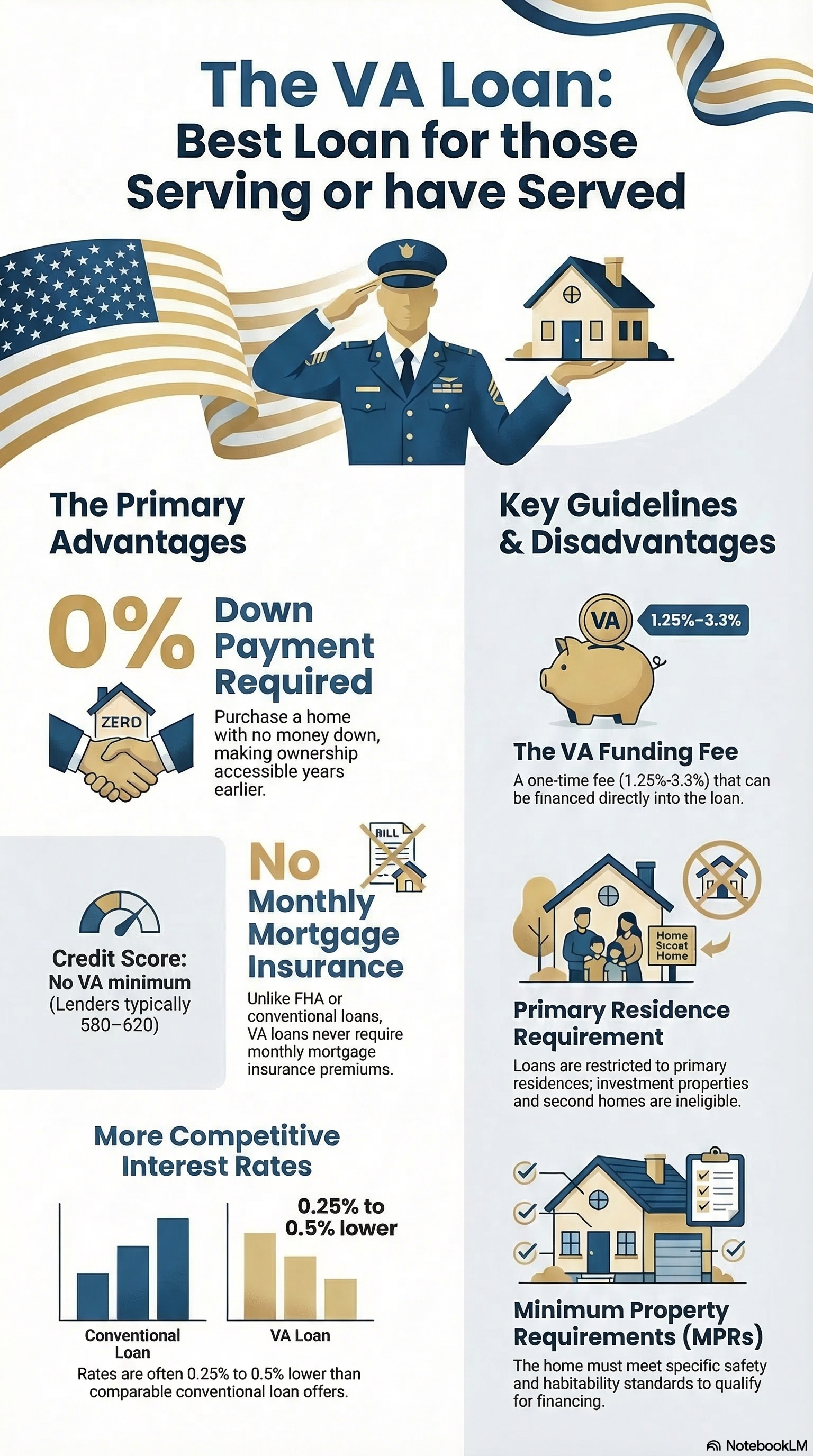
What it is: A VA loan is backed by the Department of Veterans Affairs and available to eligible veterans, service members, and certain surviving spouses. VA generally does not require a down payment or private mortgage insurance, although a lender may require a down payment in some situations. A Certificate of Eligibility and VA and lender underwriting are required. [3] benefits.va.gov
Entry requirements: The VA itself does not set a minimum credit score; the lender does, and most lenders look for around 620. You also need your Certificate of Eligibility and a primary-residence intent, because the VA benefit is built around living in the home, not buying it to rent out.
The money trade-offs: The headline numbers are zero down and no monthly mortgage insurance, which is why VA is the strongest loan for most eligible borrowers. The one fee to watch is the one-time VA funding fee, and it can be financed into the loan rather than paid out of pocket. On a $300,000 purchase at the first-use rate, that is around $6,450 rolled into the balance, roughly $40 a month, a trade most veterans happily make instead of saving a full down payment. Veterans with a service-connected disability rating may be exempt from the funding fee entirely.
When it wins: If you served, VA wins. Period. Zero down, no monthly mortgage insurance, and by far the most forgiving path when you relocate every few years. Ask me about it before you look at anything else, because it is the fastest route to ownership Texas offers that group.

USDA: zero down, but the house has to fit the program
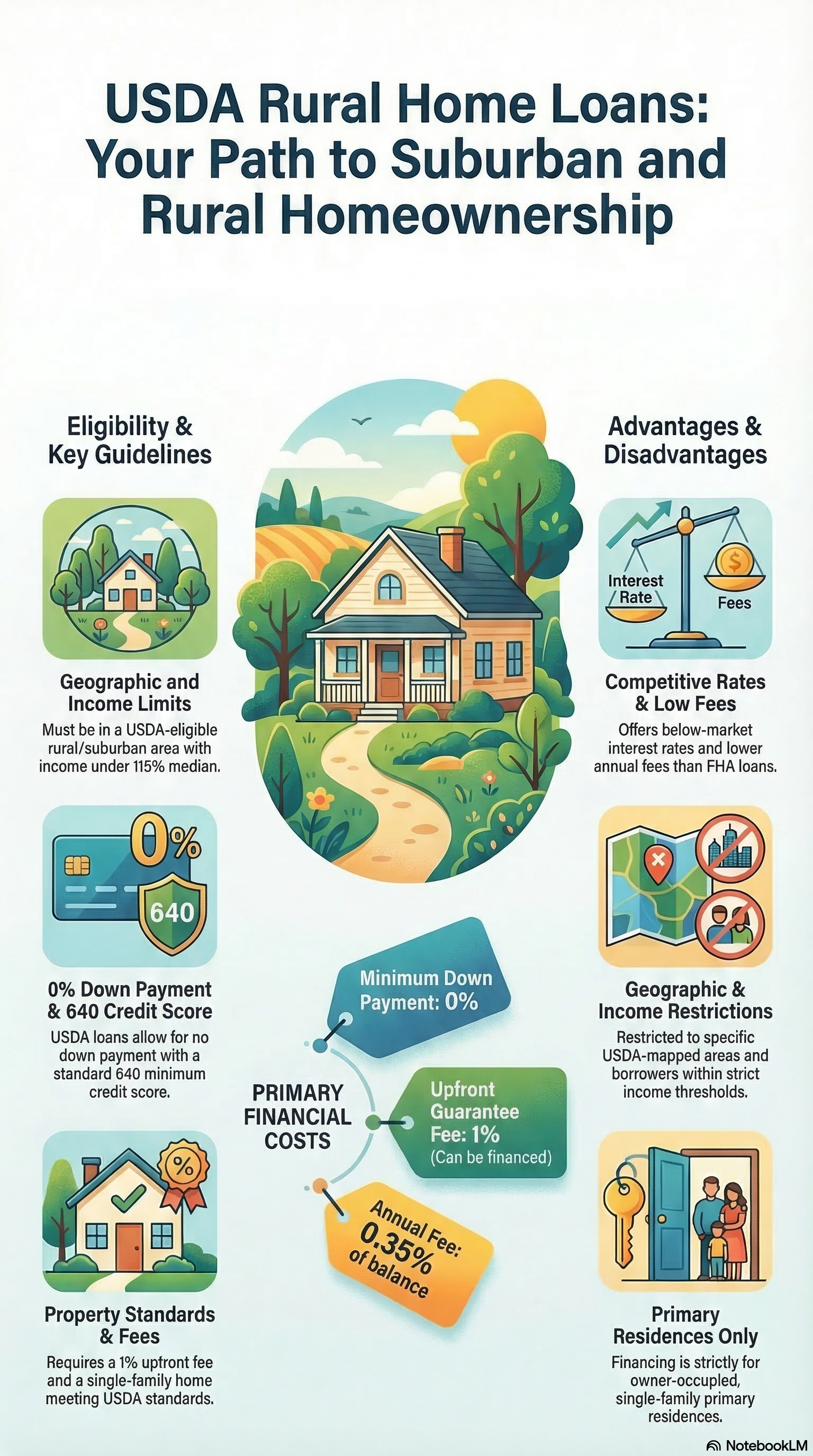
What it is: A USDA loan is backed by the U.S. Department of Agriculture and offers 100% financing, meaning zero down, for buyers purchasing a home in an eligible rural or suburban area and meeting income requirements. In Texas, that map covers a surprising number of Hill Country addresses, but not downtown San Antonio.
Entry requirements: Most lenders want a 640 or better credit score on USDA, and the program is strict about total debt, generally targeting a debt-to-income ratio around 41%. The property must be in an eligible area and the household income must stay under the county's limit.
The money trade-offs: Zero down and lower mortgage insurance than FHA sounds like a gift, and it is, until you hit the limits. USDA's tight debt requirements cap how much house you can buy. A household with $75,000 of income might qualify for about $290,000 with FHA but only around $240,000 with USDA, because the program leaves so little room for other debt.
When it wins: USDA wins when you want to live outside the city, your debt is low, and the address passes the eligibility map. For a Bulverde, Spring Branch, or Canyon Lake buyer with clean debt, it is one of the cheapest doors into a home Texas has.
The money math at a realistic Texas price: a $300,000 house
Let us make it concrete with the price range most Texas buyers actually shop, a $300,000 house, and run each program side by side. These are the same numbers I show buyers before we ever tour a property.
- FHA: 3.5% down is $10,500. Monthly mortgage insurance applies and, at that down payment, generally stays for the life of the loan. FHA typically lands cheaper per month for the same borrower, roughly $175 a month less than conventional on this price, about $2,100 a year, because the rate and insurance structure start lower.
- Conventional: 5% down is $15,000, so the same house costs $4,500 more at the closing table than FHA. PMI applies below 20% down but drops off once you hit 20% equity, which is the long-game payoff for buyers with strong credit.
- VA: Zero down, no monthly mortgage insurance. The one-time funding fee on a $300,000 first-use loan is around $6,450, and it can be rolled into the loan for roughly $40 a month instead of being paid at closing.
- USDA: Zero down and lower mortgage insurance than FHA, but the debt-to-income ceiling is the real gatekeeper. The house you can qualify for under USDA is often meaningfully smaller than what FHA would allow on the same income.
Now add Texas property taxes and homeowners insurance to every one of those payments, because in Texas the taxes are a big share of the monthly bill, and they are not optional. That is why I never quote a monthly payment without the tax and insurance numbers plugged in, and why the correct move is to compare the full monthly payment and the full cash to close, not the down payment alone. A lower down payment is not automatically the lowest-cost loan.
Which to pick: the plain-English rule of thumb
Here is the short version, Patriot Nation:
- Did you serve? Start with VA and do not let anyone talk you into another loan until you have seen the VA numbers. Zero down and no monthly mortgage insurance is hard to beat.
- Do you want to live outside the city with low debt? Run USDA before you buy anything, the income and address limits will tell you fast if it is even in play.
- Great credit, 720 or better, and staying put 7 to 10 years? Conventional is the endgame, because the PMI comes off and the long-term cost wins.
- Everyone else? FHA gets you in the door for less cash with more breathing room, and the refinance down the road is the escape hatch, not the plan.
The rule is simple: compare the same house under every loan you could qualify for, look at the total monthly payment and the cash to close, and pick the one that leaves you money in your pocket at closing and a payment you can live with at year three. That is the whole trick, and it is the conversation I run with every buyer. For buyers stacking Texas DPA on top of the loan, TDHCA's 2026 My Choice matrix lists FHA, VA, and conventional options, while My First Texas Home lists FHA, VA, and USDA options. [4] MCTH_Program_Matrix
Watch Patrick break down the best first-time buyer loan
This is the exact conversation I have with buyers on camera: credit scores, down payments, debt limits, and mortgage insurance, all side by side. Grab a pen, Patriot Nation, and let us run through it.

Read the full transcript of this video, word for word. Or watch it on Patrick's YouTube channel.
Ask Patrick which loan fits you
Get a side-by-side on FHA, conventional, VA, and USDA for your situation.