

Quick Answer
Sometimes. Eligible VA and USDA borrowers may qualify for zero-down financing. Other buyers may use DPA, gifts, or seller credits, but zero down does not necessarily mean zero cash needed at closing.
Get help lowering your cash to close and buying with no down payment.
VA: zero down, no mortgage insurance, for those who served
VA-backed loans generally do not require a down payment for eligible borrowers. VA also states that lenders may require a down payment in some situations and that VA loans do not require private mortgage insurance. [1] benefits.va.gov That combination, zero down and no monthly mortgage insurance, is why VA is the strongest financing most veterans will ever be offered, and this page covers the loan program only.
The costs to watch: the one-time VA funding fee, which can be financed into the loan instead of paid out of pocket, and can be waived for veterans with a qualifying service-connected disability rating. The fee rate depends on down payment, first use, and service type.
The catch: VA is for your primary residence. You buy it to live in it, not to rent it out on day one, and the lender still underwrites your credit and income. If you served, this is the first loan to ask about, and the answer will usually save you the most money.
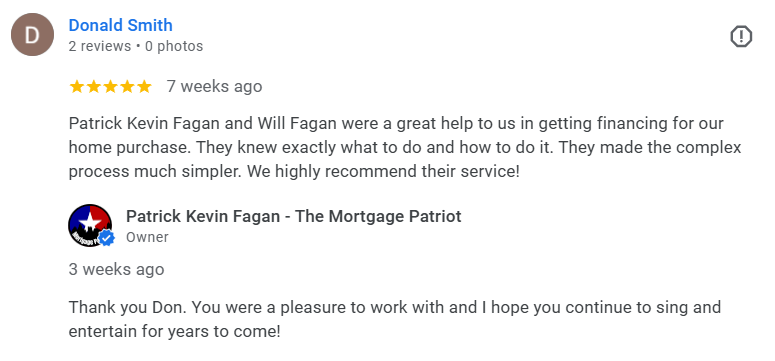
USDA: zero down in eligible areas, with income limits
USDA's Single Family Housing Guaranteed Loan Program provides 100% financing for qualifying buyers purchasing eligible homes in eligible rural areas. Household income and property eligibility must be verified through USDA and the lender. [2] Rural Development
The costs to watch: an upfront guarantee fee and an annual fee, both lower in practice than FHA's monthly mortgage insurance, and a strict debt-to-income guideline that typically caps total debt around 41%. The income limit is tied to the county, so a household that qualifies in one county may not qualify in another.
The catch: the address has to pass the USDA eligibility map, and the income ceiling is real. Zero down sounds unlimited, but the program's debt limits pick the house before you do, which is why the same income can buy more elsewhere.
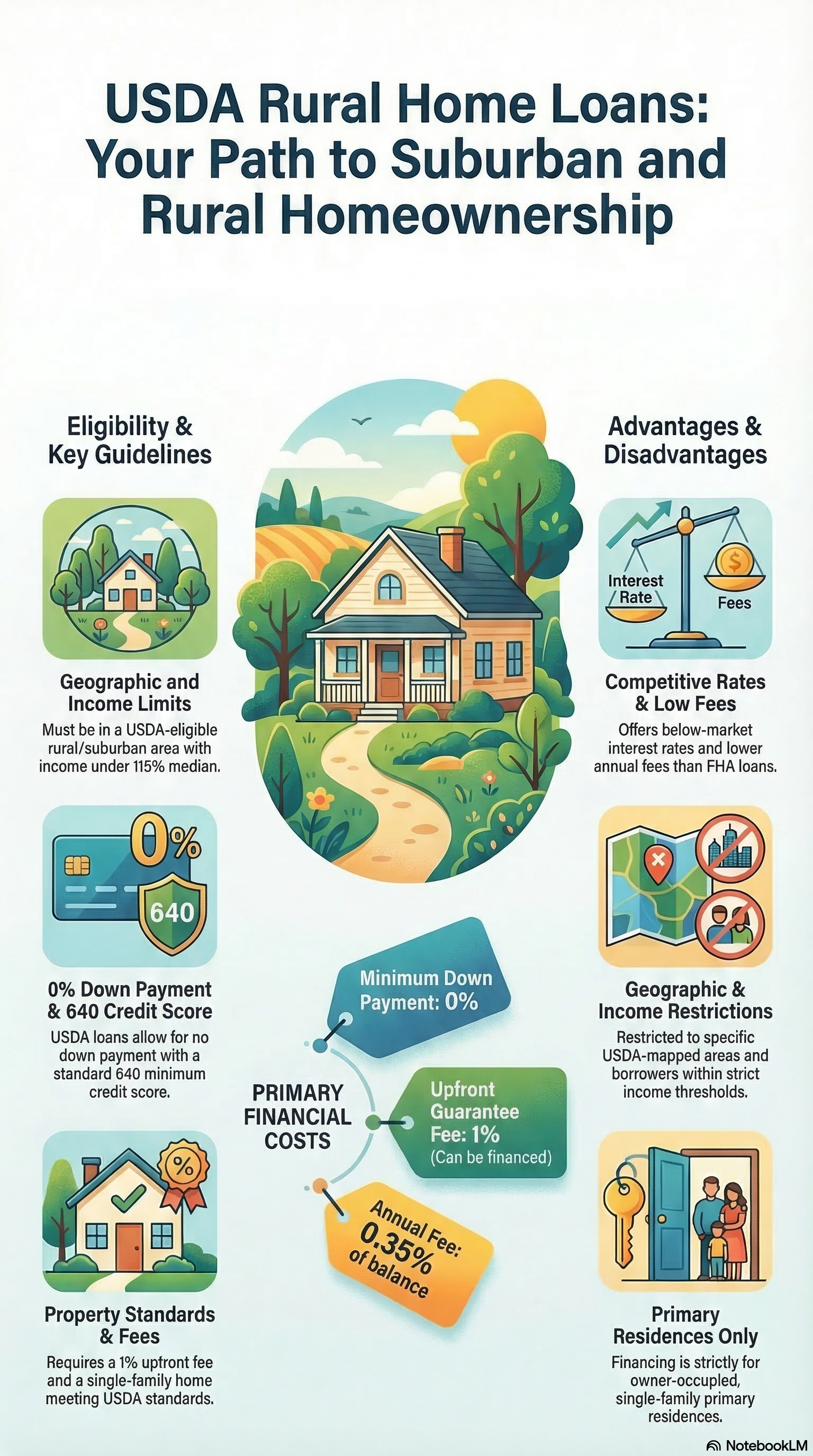
Down payment assistance: grants vs second liens, and the honest costs
FHA financing can require as little as 3.5% down, and conventional loans can be available with as little as 3% down for eligible borrowers. [3] hud.gov Texas DPA programs may help cover a required down payment or closing costs when their rules permit, and TDHCA's 2026 matrices list assistance options for FHA, VA, USDA, and certain conventional loans. [4] MFTH_Program_Matrix
Grants: money that never has to be repaid. This is the closest thing to free money in the program, and it is capped by dollar amount or percentage so every program guards it.
Forgivable second liens: a 0% second mortgage that is wiped out if you live in the home for the forgiveness period, typically three years under the Texas programs, and repaid if you sell or refinance before then.
Repayable second liens: a deferred 0% loan that stays on title and comes due when you sell, refinance, transfer, or pay off the first mortgage. It lowers your cash to close today and becomes a bill at the exit.
The honest costs and gates: income caps that vary by county and household size, credit minimums that are usually 620 or better even when the underlying loan allows less, purchase price caps that change with the program, a required homebuyer education course, and the fact that the assistance sits on your title as a second lien. It is fantastic help, but it is structured help with rules, and the rules are exactly what we check before you fall in love with a house.
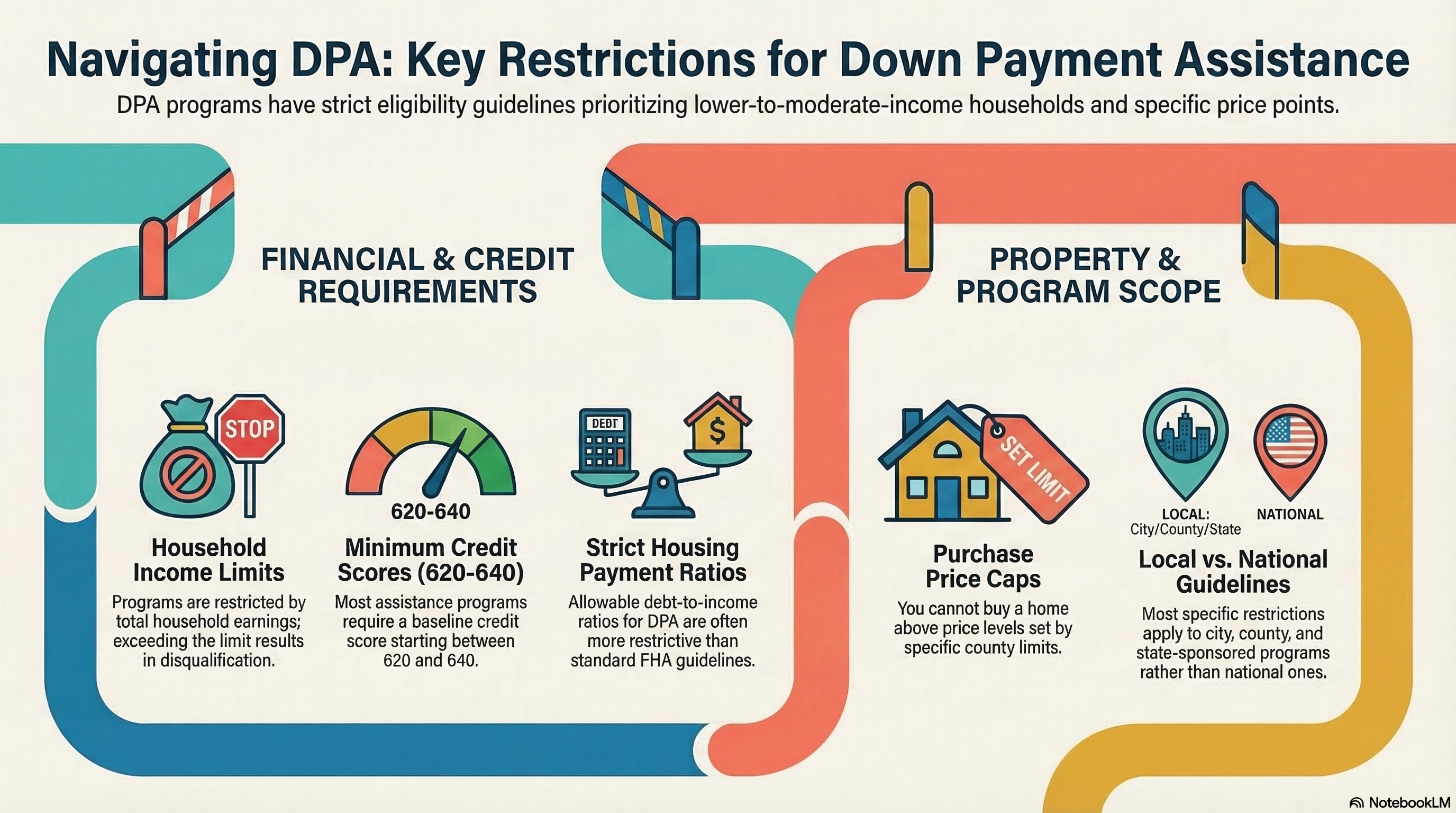
One worked real-world close: a $245,000 home for about $3,000 out of pocket
Here is what this looks like when it actually closes, a real-world example I have walked buyers through: a $245,000 home bought for roughly $3,000 out of pocket with down payment assistance. The loan covers the purchase, the assistance program covers the down payment, and the buyer's own money covers only the unavoidable bits the program does not touch.
The math matters more than the marketing: a $245,000 loan at a conventional 3% down needs $7,350 before closing costs, and at FHA 3.5% it needs $8,575. Drop a Texas DPA grant or forgivable second lien on top at the typical 3% to 5% of the loan, and the down payment disappears from the buyer's side of the ledger entirely, leaving a few thousand dollars for the pieces that always remain, the inspection, the option fee, the prepaids, the moving truck.
That is the honest version of "no money down": not literally zero cash, but a closing check small enough to fit a starter savings account, in exchange for homework, program rules, and a second lien you either live out or repay on the exit. [5] Consumer Financial Protection Bureau explains that cash to close includes the down payment and closing costs, reduced by deposits, credits, and other adjustments, which is exactly how this close gets so low.
The honest trade-off of zero down
Zero down is not free, it is financed. Somewhere, the cost shows up: a VA funding fee on your balance, a USDA annual fee in your payment, FHA mortgage insurance that travels with the loan, or a DPA second lien that either forgives slowly or comes due at the exit. The cheapest entry ticket and the cheapest long-term loan are rarely the same product.
The other trade is reserves. "No down payment" does not mean "no cash needed." You may still need money for inspections, earnest money, an option fee in a Texas contract, appraisal, prepaid taxes and insurance, moving costs, reserves, or costs that the assistance program does not cover. I have seen buyers close at 0% down with nothing left for the water heater in month three, which is why the safest approach is to ask for a written cash-to-close estimate under each eligible loan option, and to plan a real cushion before you sign.
Watch: buy a $300,000 home with about $1,000 down
This is the video where I run the exact combination, FHA plus down payment assistance plus seller concessions, that took a $300,000 home all the way down to a roughly $1,000 closing check.

Read the full transcript of this video, word for word. Or watch it on Patrick's YouTube channel.
Ask Patrick about no down payment options
Get a straight answer on VA, USDA, and DPA options that can get you in with little or no down payment.