
The math slaps every first-time buyer the same way: you found the house, the payment works on paper, and then the closing table asks for $12,000 to $18,000 in cash you do not have. Down payment assistance is the tool built for that exact moment, and most buyers never ask about it until it is too late to use it. Here is what DPA actually is, who qualifies, how it gets paid back, and what the numbers look like on a real Texas closing.
Quick Answer
Down payment assistance is money a qualified buyer uses to cover the down payment and sometimes the closing costs. In Texas it comes as a true grant that is never repaid, or more often as a second lien layered on top of the first mortgage. It is not free for everyone and it is not automatic, but for the buyers who qualify it routinely turns a five-figure closing check into a few thousand dollars.
Get help lowering your cash to close with down payment assistance.
What down payment assistance is: grants vs second liens
Down payment assistance is not one thing. It is a bucket of programs, and every one of them works the same at the starting line: a state, city, or county program puts money toward your purchase so you bring less cash to closing. The difference is what happens after you close, and that difference is the whole game.
The true grant. A real grant never needs to be repaid. You get the money, you buy the house, and the program never sends you a bill. Genuine grants exist, but they are the rarer flavor.
The second lien. Most Texas assistance is a second mortgage recorded behind your first loan. Some of these are forgiven after you live in the home long enough, typically a few years of occupancy. Others are deferred, meaning there is no monthly bill but the balance comes due when you sell or refinance. And some are repayable second liens with their own monthly payment, which matters because that payment is real money you qualify for and pay every month.
Dollar impact: on a $245,000 purchase with a 3.5% down payment, the down payment alone is about $8,575. A DPA program that covers 3% to 5% of the loan amount can erase most of that number before you ever write a check.
Who qualifies: the income, credit, and price-cap gate
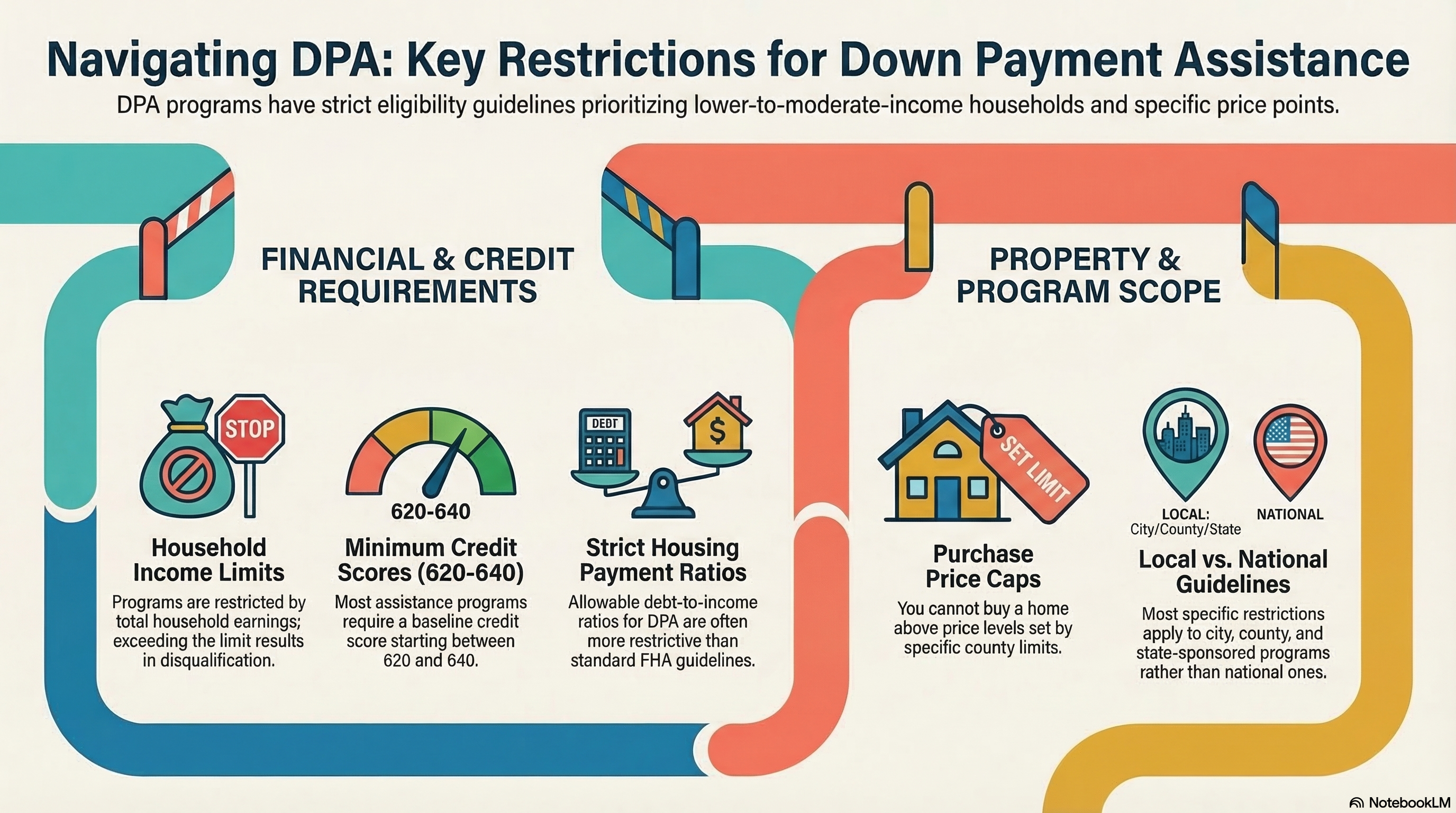
DPA is not for everyone, and that is by design. The programs are funded to help buyers who could own a home with a hand up. The gate has a few moving parts, and you need to clear all of them:
- Income under the area median. Most programs want your household income under a percentage of the county's area median income, typically about 80%. Earn more and the door closes, even with perfect credit.
- Credit around 640. DPA programs usually set their own minimum score, commonly around 640, which runs above what the underlying loan allows. Some programs clear at 620; few go below.
- Housing-ratio limits often tighter than FHA. FHA is famously lenient on how much of your income can go to housing. DPA programs frequently draw the line tighter, so a buyer who qualifies for the loan can still miss the assistance.
- County purchase-price caps. Each program caps the price of the home you can buy, and the cap belongs to the county where the house sits, not where you live.
- Location roots. Many programs want you to live in the home and stay put, often for a minimum period such as 6 months, before things like refinancing or selling get complicated.
Real-world consequence: these gates are checked by the program and by underwriting, not by the listing. A buyer who walked in assuming a 600 score and a $260,000 target in a $250,000-cap county finds out in underwriting, not at the open house. Ask the questions in the first conversation.
How it gets paid back: real second liens with real payments
Here is the sentence most buyers never hear until the Closing Disclosure lands: some down payment assistance is a second mortgage, and a second mortgage can have a payment.
On a typical small second lien from a Texas program, the monthly payment lands around $80 a month. That does not sound like much next to the first mortgage, but it is real, it is counted in your debt-to-income ratio, and the lender has to qualify you for it just like the first loan.
Other structures dodge the monthly bill. A deferred lien has no payment at all, but the balance sits against the property until you sell, refinance, transfer, or pay off the first mortgage. A forgivable lien is wiped out if you stay in the home for the forgiveness window, commonly 3 to 5 years of on-time, in-residence living, and then it behaves like money you never borrowed.
The rule to live by: never accept the word "assistance" as a full answer. Ask your loan officer whether it is a grant, a forgivable lien, a deferred lien, or a monthly-payment second lien, and get the repayment terms in writing before you fall in love with the down payment help.
The honest costs: run the full payment math, not just the down payment
The trap with down payment assistance is that the marketing sells the money down and hides the rest of the payment. Programs sometimes carry higher-than-market rates on the first mortgage, because the below-market part of the deal is the assistance itself. Some add a costly second lien with a payment and fees of its own.
Dollar math that matters: a second-lien payment of $80 a month is $960 a year, and on a 30-year loan it is real money over the life of the loan. Add a first mortgage priced a quarter point higher than the street rate, and the "free" down payment can cost more every month than the cash it saved at closing.
That is why the whole exercise has to be one comparison: total monthly payment with assistance against total monthly payment without it, on the same house, same price, same day. If the assisted payment wins and the out-of-pocket number is manageable, use it. If the unassisted loan is cheaper every month and you have the cash, the honest answer is to skip the program.
A worked real-world example: a $245,000 home for roughly $3,000 out of pocket
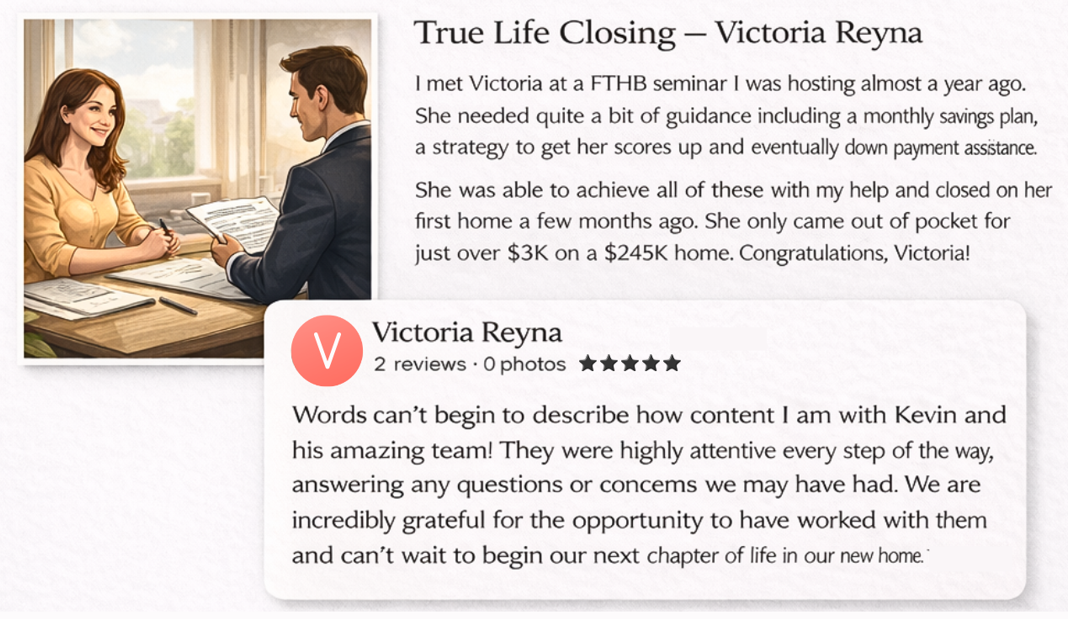
Here is the shape of a real file, the one Patrick walks buyers through over and over. A first-time buyer in the San Antonio area finds a home priced around $245,000. On paper, a 3.5% down FHA purchase wants about $8,575 down plus closing costs, easily a $12,000-plus day at the title company.
With down payment assistance layered in, the pieces land differently. The DPA covers the down payment, seller concessions pay a big share of the closing costs, and the buyer's own money shrinks to the earnest money and the few costs the program does not touch. The result: the buyer closes for roughly $3,000 out of pocket on a home they own, not rent.
Real-world consequence: the buyer who was months away from saving a full down payment buys now, on a payment they can already handle. That is the difference between renting through another year and building equity from a $3,000 start.
How often Patrick's buyers actually use it
The honest answer is a lot. The large majority of Patrick's qualifying buyers use down payment assistance on their purchase. Not because the programs are a gimmick, but because the math works: qualify for the program, and the difference between renting and owning is usually a few thousand dollars of your own cash.
The buyers who miss out are not the unqualified ones, they are the ones who never asked. DPA is confirmed as part of the loan file, so the question belongs in the first conversation with your loan officer, before you are under contract and out of time.
Watch: the low-cash-to-close play in action
This is the video where Patrick runs the exact combination, FHA plus down payment assistance plus seller concessions, that takes a purchase all the way down to a roughly $1,000 closing check.

Read the full transcript of this video, word for word. Or watch it on Patrick's YouTube channel.
Ask Patrick which DPA programs fit you
Find out which Texas down payment assistance programs match your income, loan type, and timeline.
