

You're a first-time buyer and every loan officer is shouting a different acronym at you: FHA, Conventional, VA, USDA. Which one actually saves you money at closing and every month after? That is the right question to ask, so let's kick off this rodeo right now.
Quick Answer
The best loan depends on your credit, income, cash, military eligibility, property location, and goals. Compare conventional, FHA, VA, USDA, and Texas DPA options using total monthly payment and cash to close.
Get help comparing your loan options as a first-time buyer.
What is the best loan for a first-time buyer?
There is no single best first-time-buyer loan. The best choice is the one that fits your credit, income, debt, cash, property, and expected time in the home.
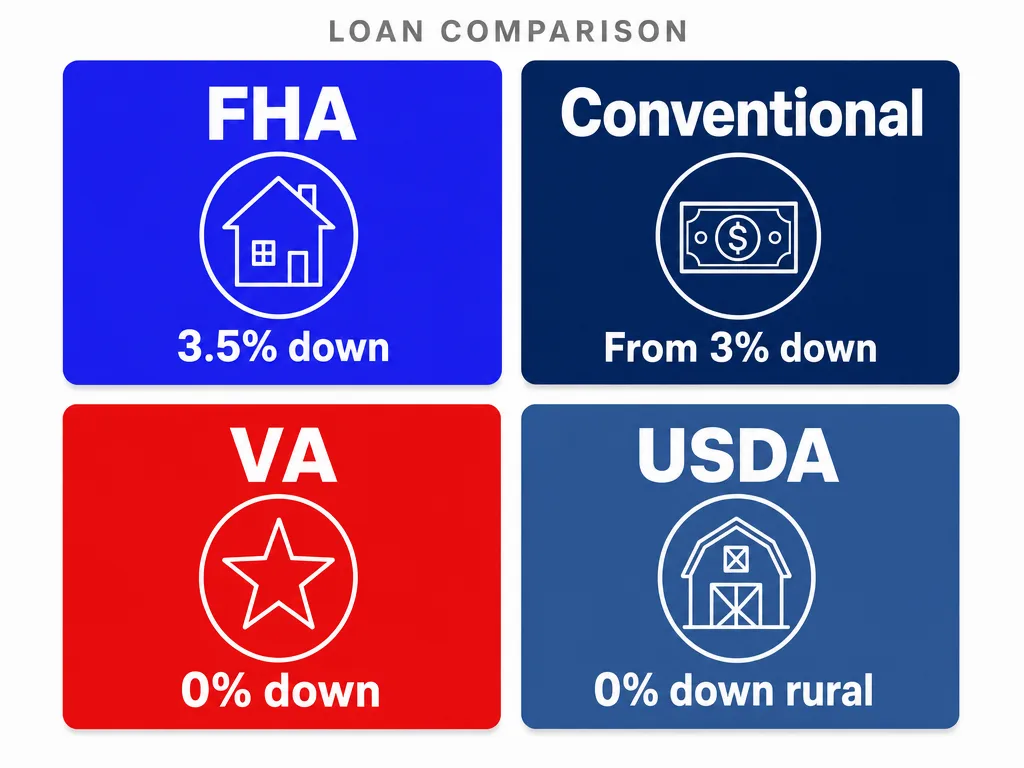
A conventional loan can be available with as little as 3% down and may be attractive when you have stronger credit and want conventional mortgage insurance that can eventually be canceled under applicable rules. [1] Fannie Mae
An FHA loan can require as little as 3.5% down and may be useful for buyers who need flexible credit or a smaller down payment, but FHA mortgage insurance applies. [2] hud.gov
A VA loan may be the strongest starting point for an eligible veteran or service member because VA generally does not require a down payment or private mortgage insurance. VA eligibility and lender requirements still apply. [3] benefits.va.gov
A USDA loan may provide 100% financing for eligible buyers purchasing in eligible rural areas and meeting income requirements. [4] Rural Development
Texas first-time buyers may also compare TDHCA My First Texas Home, which pairs assistance with FHA, VA, or USDA financing and requires homebuyer education. [5] MFTH_Program_Matrix
Do not choose by down payment alone. Compare the full monthly payment, mortgage insurance, property taxes, homeowners insurance, HOA costs, lender fees, assistance repayment terms, and cash to close. CFPB recommends comparing loan offers from multiple lenders. [6] Consumer Financial Protection Bureau
The four loan programs, in plain English
Spoiler alert, Patriot Nation: there are only four real loan programs for first-time buyers, and most of you will only qualify for two of them. Here is each one, what it means, what it costs you in dollars, and what happens in the real world when you pick it. The full picture, every program on paper, lives in my Essential First-Time Homebuyer Roadmap.
FHA: the first choice for most first-time buyers
What it is: The Federal Housing Administration backs the loan, which means the lender can take more risk on you: less money down, lower credit, more debt on your plate.
What it costs: A low 3.5% down payment, and it works from a 580 credit score. FHA allows more debt relative to your income than conventional, and it is the program most down payment assistance in Texas is tied to. If you want help with the down payment, FHA is usually where that help plugs in.
The real-world catch: You pay a monthly mortgage insurance premium that never goes away on its own. With 3.5% down, that insurance stays with you for the life of the loan unless you refinance or sell.
Conventional: the fallback that becomes the finish line
What it is: A plain mortgage backed by Fannie Mae or Freddie Mac, no government insurance attached. Lenders set the rules, so it is the loan you reach for when FHA does not fit you, or when your credit is strong enough to qualify for the better deal.
What it costs: A higher down payment and a slightly higher rate than FHA for most buyers, and if your scores are under 680 the monthly mortgage insurance actually costs more than FHA's. The reward shows up later: conventional mortgage insurance drops off once you hit 20% equity, and then it is gone for good.
The real-world play: Conventional is the pick when you have great credit, think 720 or better, and plan to stay put 7 to 10 or more years, long enough for the equity to cancel the insurance and the lower long-term cost to win.
VA: the wealth-builder loan
What it is: The obvious choice for active military and veterans. The Department of Veterans Affairs backs the loan, so the lender is protected and the borrower gets terms civilians cannot touch.
What it costs: Zero down, no monthly mortgage insurance, and very low rates. The one fee to watch is the upfront funding fee, and even that is waived at 10% or more disability.
The real-world edge: This is the wealth-builder loan. Veterans can buy a home every few years and rent out the prior one, so each tour or PCS can stack another rental property while the equity keeps growing. If you served, ask me about this loan before you look at anything else.
USDA: zero down, but the house has to fit the program
What it is: One hundred percent financing for buyers in eligible rural and suburban areas who keep their debt low. The U.S. Department of Agriculture backs the loan, hence the name.
What it costs: Zero down and lower mortgage insurance than FHA. The price comes in the limits: USDA's tight debt-to-income requirements cap how much house you can buy. A $75,000 income might buy $290,000 with FHA but only about $240,000 with USDA.
The real-world catch: If you want to live outside the city, keep your debt low, and buy in a spot the maps say is eligible, this is a bargain. Just know the income and debt limits pick the house before you do.
The money math that matters: FHA vs conventional on a $300,000 house
Let's make this real. Take a $300,000 purchase with 3.5% down on an FHA loan. That is $10,500 out of pocket. Conventional on the same house typically wants 5% down, which is $15,000. That $4,500 difference is real cash you keep at closing.
And it does not stop at the down payment. For the same borrower, FHA typically lands roughly $175 a month cheaper than conventional. That is about $2,100 a year, every year, staying in your pocket. FHA also lets you carry more debt relative to your income, and it is the loan most down payment assistance programs hook into, which can shrink your cash to close even further.
Now the honest trade-off, because my whole job is to be on your side and show you the whole board. With FHA, that monthly mortgage insurance premium never drops off on its own. With conventional, the mortgage insurance falls away automatically once you hit 20% equity. That is the single biggest reason so many buyers start FHA and then refinance into conventional once they have built that equity: use FHA to get in the door for less, build equity for a few years, then trade into the loan that cuts the insurance loose and keeps the savings going.
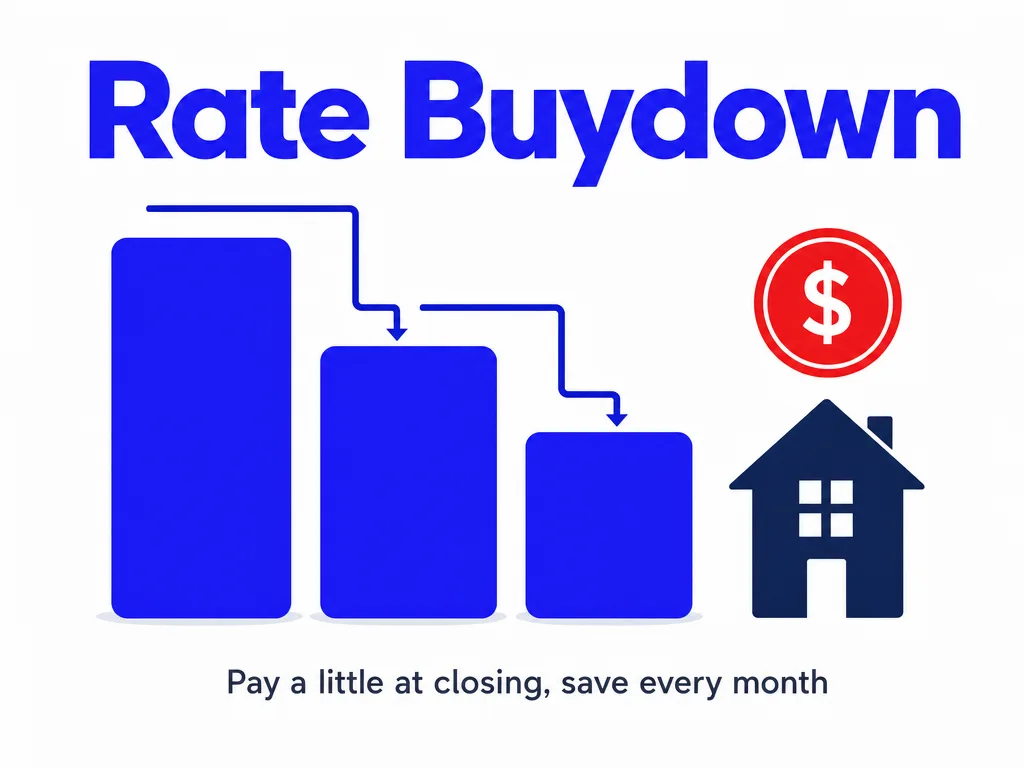
And if you want to attack that monthly payment from the rate side instead, a rate buydown is one of my favorite creative tricks: pay a little extra at closing to buy the rate down, and the payment shrinks for the life of the loan. Pair that with FHA's lower monthly cost and you are stacking two money savers on top of each other.
When to pick which loan
Here is the short version, Patriot Nation: use FHA unless you can't. Use conventional if you've got great FICOs and plan to live there 10 or more years. Use VA if you're active or retired military. Use USDA if you want to live outside the city and keep your debt low.
Most first-time buyers I talk to land on FHA first, because it gets them in the door for less money with more breathing room. The refinance later is the escape hatch, not the plan.
Watch Patrick break down the best first-time buyer loan
This is the exact conversation I have with buyers at the kitchen table, on camera: credit scores, down payments, debt limits, and mortgage insurance, all side by side. Grab a pen, Patriot Nation, and let's run through it.

Read the full transcript of this video, word for word. Or watch it on Patrick's YouTube channel.
Ask Patrick about first-time buyer loans
Get a clear recommendation on the best loan type for your first home purchase.