
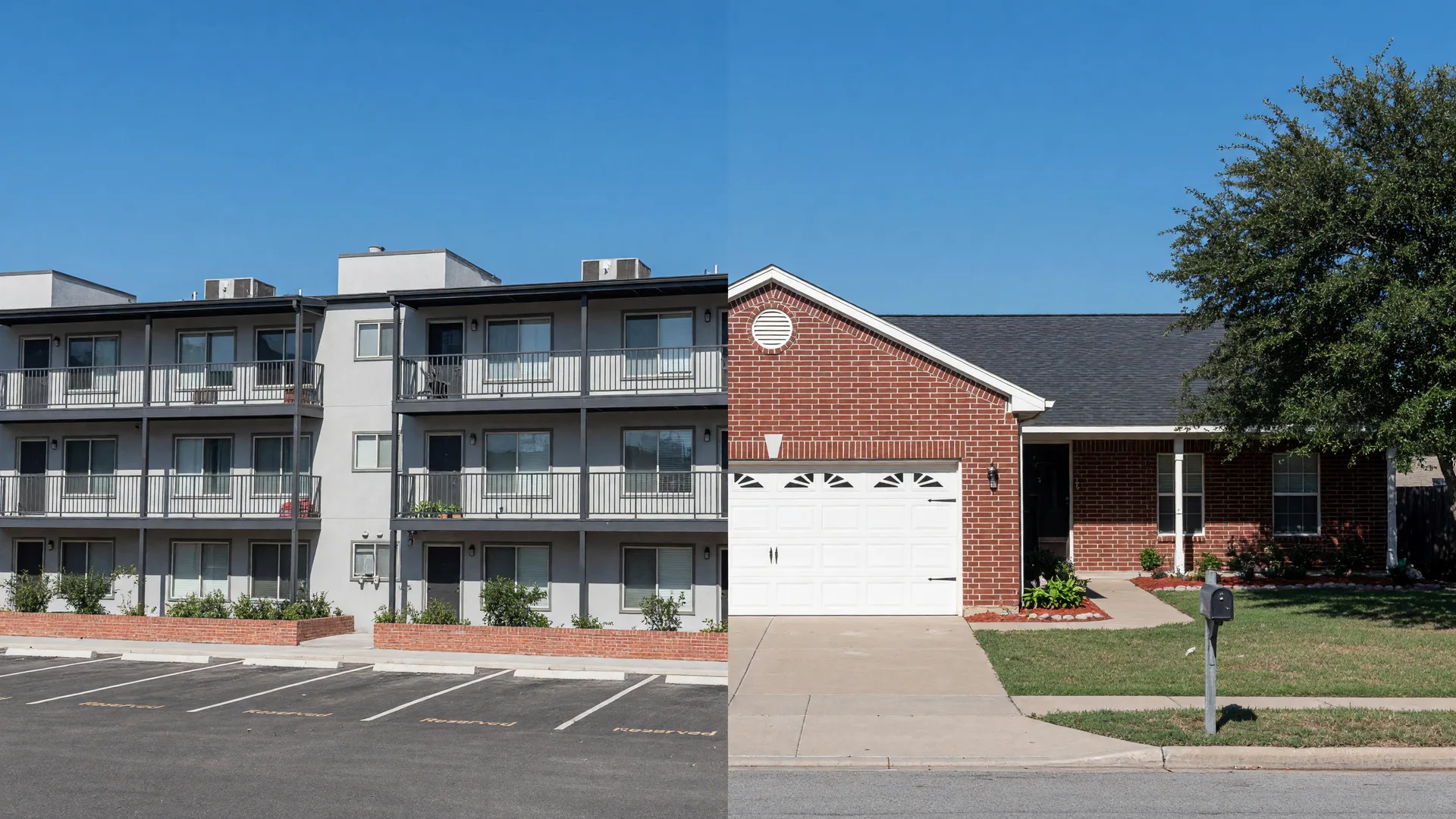
Patrick's Quick Answer
In 2026's balanced San Antonio market, buying usually builds equity and fixes your housing cost, while renting keeps flexibility and a much smaller upfront outlay. The honest answer depends on three things: how long you'll stay (buying typically needs a few years to beat renting), how strong your cash position is, and the exact gap between your rent and the total monthly cost of owning. Run those three numbers and the decision usually makes itself.
"Should I rent or buy?" is the most loaded question in real estate, because the honest answer is always "it depends on your life." Let's make it concrete for San Antonio in 2026, with the math you can actually use.
The honest trade-off
Renting buys flexibility: a lease ends, you can move for a job or a relationship, the landlord owns the water heater, and your upfront money is a deposit, not a down payment. Buying buys equity and stability: your payment builds ownership, you're not at the mercy of a rent increase, and you can paint, renovate, and invest in a place that's yours.
Neither is morally superior. They're different tools for different seasons of life, and the smartest buyers I know rented for a while before they were ready to own.
Building the comparison
The correct way to compare is rent versus the full monthly cost of owning, not rent versus the mortgage payment alone. Owning has five payment components:
- Principal and interest on the mortgage
- Property taxes, usually escrowed monthly
- Homeowners insurance, also escrowed
- HOA fees, where the property has them
- Mortgage insurance, on loans that require it
Add maintenance to that, roughly a percent of the home's value a year as a rule of thumb, and you have the true cost of the buy side. Most rent-vs-buy arguments fall apart when one side compares rent to P&I only, because that's comparing apples to oranges. I break the components down in my what's actually in my monthly payment answer.
The timeline test
The timeline is the first filter. Buying costs money up front in the down payment and closing costs, and it takes years for that money to be repaid through equity build-up and appreciation before you break even versus renting. The commonly used guidance is that you should generally plan to stay put for a few years at minimum, and the longer you stay, the stronger the buy case gets.
If you might move in a year or two, for a job, a PCS, or life reasons, renting is often the smarter math, because the closing costs and the buying costs get spread over too few years. If you're in San Antonio for the long haul, the equity argument compounds in your favor.
Here's the key: the timeline test comes first. If you can commit to several years in the home, buying has a real shot at winning. If you can't, stop the analysis and keep renting.
Cash to close vs. security deposit
The upfront cash is where the two paths diverge hardest. Renting typically costs a deposit and the first month's rent. Buying costs the three buckets of cash to close: down payment, transaction costs, and prepaids, which I detail in my cash to close guide.
If you don't have the cash position yet, that's not a moral failing, it's a timing fact. Texas down payment assistance and VA and USDA zero-down options can change the picture for qualifying buyers, so check what's available before you assume you can't afford to own.
San Antonio specifics
- Prices. San Antonio's prices sit below many big metros, which means the monthly cost to own a typical home can be competitive with renting a comparable place.
- DPA. Texas DPA programs can cover some or all of a down payment, a real advantage over renting and saving for years.
- Jobs and JBSA. San Antonio's growing job base and the military presence keep rental demand and ownership demand both strong, which supports values over time.
- Market tone. In the balanced 2026 market, buyers have negotiation room, which narrows the gap between renting and owning.
When renting is the right call
Rent if you'll be in town briefly, if your job or family situation is in flux, if you're still building the cash position, or if renting lets you save faster than a stretched purchase would. There's no shame in any of those, and the people who rent on purpose usually buy stronger later. My rent vs. own guide runs the full comparison in more depth.
Let's run your rent vs. buy numbers for real.
Bring me your rent, your target price, and your savings, and I'll show you the true monthly cost of owning versus renting, including taxes, insurance, HOA, and the time it takes to make buying worth it.
Frequently Asked Questions
Is it cheaper to rent or buy in San Antonio in 2026? Tap to expand
How long do I need to stay in a home for buying to make sense? Tap to expand
Can I buy in San Antonio with little or no money down? Tap to expand
Decide with math, not memes
Rent-vs-buy internet takes are free and usually wrong for your exact life. Let's put your numbers on a page and see which side wins for you.
About Patrick Kevin Fagan, REALTOR®
Patrick Kevin Fagan is a Texas Real Estate Sales Agent (#454749) with AXEN Realty LLC and a Senior Loan Officer (NMLS ID #877741) with NEXA Mortgage, LLC (NMLS #1660690). He brings 23+ years in mortgage lending and 19 years in real estate, serving homebuyers, homeowners, and sellers across Greater San Antonio and the Texas Hill Country.
Answered by Patrick Kevin Fagan
Texas Real Estate Sales Agent #454749, AXEN Realty LLC · Senior Loan Officer, NMLS ID #877741, NEXA Mortgage, LLC
Call or text: 210-317-6514
The comparison in this post is directional and based on rounded examples. Your actual numbers depend on the property, the rate, your tax and insurance costs, and your timeline, so run the real math for your situation.
