

Here is the money problem, Patriot Nation: a security deposit is the only money you hold that is not yours, and Texas gives you a strict clock to hand it back. Follow the rules and the deposit protects you; improvise, and a bad-faith finding can cost you the whole deposit plus penalties and attorney's fees.
Quick Answer
Texas sets no legal cap on security deposits, but the law is strict on returns: refund within 30 days of move-out with itemized deductions for damage beyond normal wear. Document condition at move-in and the disputes mostly disappear.
Ask Patrick how Texas security deposit rules would apply to your rental.
The Law: Texas Property Code Chapter 92
Security deposit rules sit in Texas Property Code Chapter 92, and landlords who follow them have little to fear, while those who improvise forfeit the whole deposit. There is no statutory cap on the amount you can charge, so the market sets it, commonly one to two months' rent.
The money meaning is that the deposit is not free cash you collect, it is a fund the law protects for the tenant. Charge a reasonable market amount, hold it properly, and return it on time, and the deposit becomes a smooth, low-risk part of the business.
The 30-Day Clock Starts at Surrender
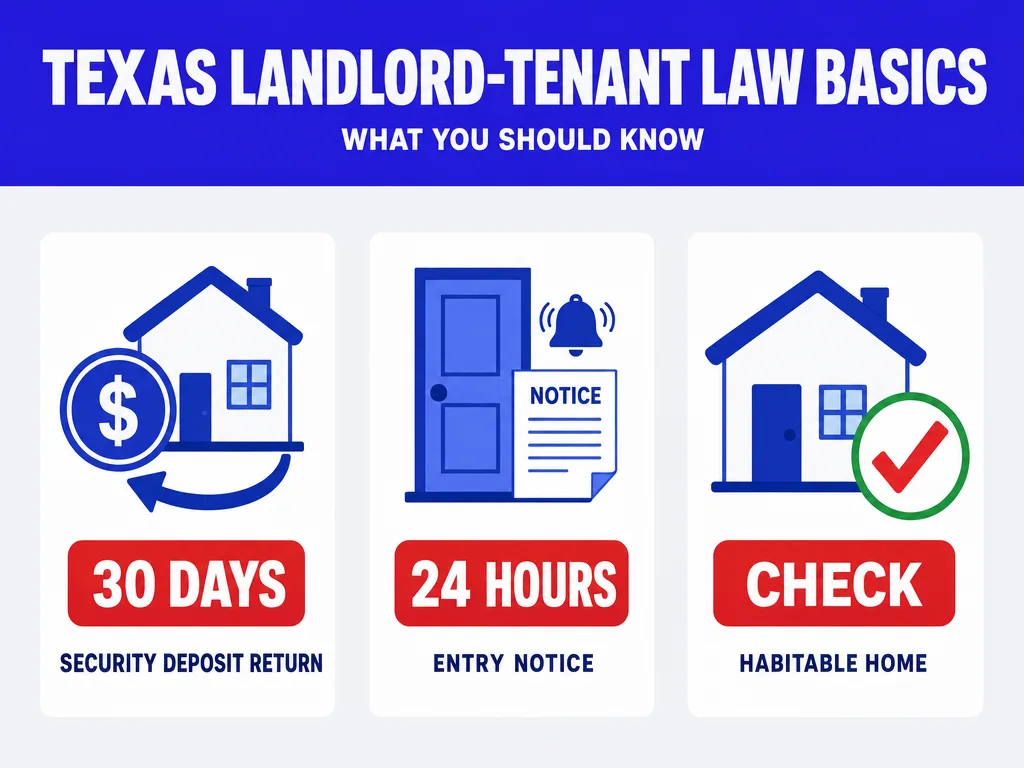
The deposit must be returned on or before the 30th day after the tenant surrenders the premises, and any money you keep must be justified by itemized deductions for unpaid rent or damage beyond ordinary wear and tear. The countdown starts at surrender, not when you get around to it.
Extensions are not a right, so mail the response with proof and time to spare. A documented surrender date and the itemized deduction list should go out together, inside the deadline, every single time.
What You Can Keep and What You Can't
You can deduct for unpaid rent, damages beyond normal wear and tear, and lease violations, but you cannot deduct for ordinary wear: the carpet that aged normally, the paint that faded, the scuffs of daily life. That line between wear and damage is where most deposit disputes live.
The money lesson is that the itemized list makes the deduction stick. Show the tenant exactly what was deducted and why, tie each line to a documented condition, and the deposit process stays clean instead of turning into a dispute.
The Teeth: Bad Faith Is Expensive
The teeth of the law are stiff: a landlord who withholds a deposit in bad faith, or fails to provide the itemized accounting, can forfeit the right to keep any of it and can face penalties and attorney's fees. One careless handling of a deposit can cost far more than the deposit itself.
The real-world consequence is that documentation is not paperwork, it is your defense. A move-in inspection with photos, a signed checklist, and a dated statement of deductions at move-out are the evidence that makes deductions stick and keeps you on the right side of the law.
Evidence Wins: Photos and Checklists
Photo-document both move-in and move-out with a signed checklist, use a standard deposit-deduction form, and keep the file for several years. Clean process is what protects the deposit as an asset instead of turning it into a judgment.
The money payoff of good evidence is that disputes become rare, and the ones that happen get resolved fast. A landlord with photos and a signed checklist rarely loses a deposit argument, because the proof is already in the file.
Keep Records, and Transfer Them
Keep the records for several years after the tenancy ends, because disputes can surface long after the keys are returned. And when the property changes hands, the new owner inherits the deposit obligations, so the paperwork should transfer with the deed, not vanish with the prior landlord.
Know the 30-day clock, keep only what the law allows, and document everything. Protect the deposit, run the process clean, and make it a great one.
Ask Patrick about Texas security deposit rules
Get a straight answer on Texas security deposit rules and how the Texas rules apply to your rental.
