
Patrick's Quick Answer
Every home purchase comes down to a few key decisions: loan type, down payment size, new build versus resale, neighborhood, and how much you borrow. Each one has pros and cons that interact. Because I handle both the financing and the representation, I walk you through each decision with the real numbers, so you choose the combination that fits your budget and your life.
Almost every buyer faces the same four decisions, and none of them has a universally right answer: rent versus buy, fixed versus adjustable rate, new construction versus resale, and whether to use an agent. This article gives you the honest pros and cons of each with the numbers that matter, so the choice fits your timeline, your budget, and your tolerance for risk. Where a full deep dive exists, I link to it.
One framing note up front: every payment figure below is illustrative, based on stated rate and loan assumptions. Your actual numbers depend on your rate, taxes, insurance, and loan terms, which is exactly why we run them together before you commit.

Watch on YouTube
New Build vs Old Home: What First-Time Buyers Must Know (2026)
The new build versus resale trade-off, with the costs and timelines most buyers discover too late.
Watch the videoMore videos on The Mortgage Patriot channel.
1. Rent vs buy: the numbers and the intangibles
The buy side is not just a roof: it is forced savings. On a $300,000 home with 10% down and an illustrative 6.5% rate, the $30,000 down payment plus roughly $1,896 a month in principal and interest puts about $19,000 of principal into your pocket over the first five years, before any appreciation, all while your payment stays flat in nominal terms. Renters pay rent that historically rises at a few percent a year and build no ownership stake, but they also escape the costs owners cannot dodge.
Buying
- Builds equity with every payment and through appreciation
- Payment principal and interest stays flat for 30 years
- Control over your home, upgrades, and pets
- Cons: maintenance, taxes, and insurance are yours
- Cons: large down payment and closing costs up front
- Cons: far less flexible if life changes fast
Renting
- Low entry cost and easy, fast relocation
- No maintenance, repair, or tax bills
- Cons: rent rises over time and buys zero equity
- Cons: no control over rules, renovations, or pets
- Cons: you fund the landlord's mortgage instead of yours
The honest answer: buying usually wins for people who plan to stay 5 years or more, can cover the cash-to-close, and have stable income. Renting can win for the short-term, the uncertain, or anyone whose down payment money is still growing. My rent vs own deep dive runs the full 30-year wealth comparison, and the affordability guide helps you figure out your realistic purchase band.
2. Fixed vs adjustable rate: predictable vs potentially cheaper
A 30-year fixed locks your principal and interest payment for the full term. An adjustable-rate mortgage (ARM) starts lower and adjusts periodically after an initial fixed period, so a 5/1 ARM stays fixed for 5 years and then adjusts once a year. Rate context: the 30-year fixed averaged around 6.5% in mid-2026 per Freddie Mac, and ARMs typically price below fixed rates.
The illustrative math on a $300,000 loan: at 6.5% fixed, principal and interest run about $1,896 a month. At 5.75% on a 5/1 ARM, it is about $1,751, roughly $145 a month lower, about $8,700 over five years. After year five, the ARM adjusts, and it can go up or down, usually with adjustment caps built in (a common structure caps each adjustment at 2 points and lifetime increases at 5 points). If you know you will hold the home 5 to 7 years, or if you expect to refinance, you are paying a fee for stability you never use.
Fixed
- Payment never changes, easy to budget for decades
- Safe if you keep the home long term
- Cons: higher starting rate than an ARM
- Cons: you pay for stability you may not need
Adjustable
- Lower starting rate, real savings in the early years
- Good fit for shorter holds or planned refinance
- Cons: payment resets after the fixed period
- Cons: rising rates can raise the payment substantially
My fixed vs ARM guide walks through the caps, indexes, and scenarios in more depth.
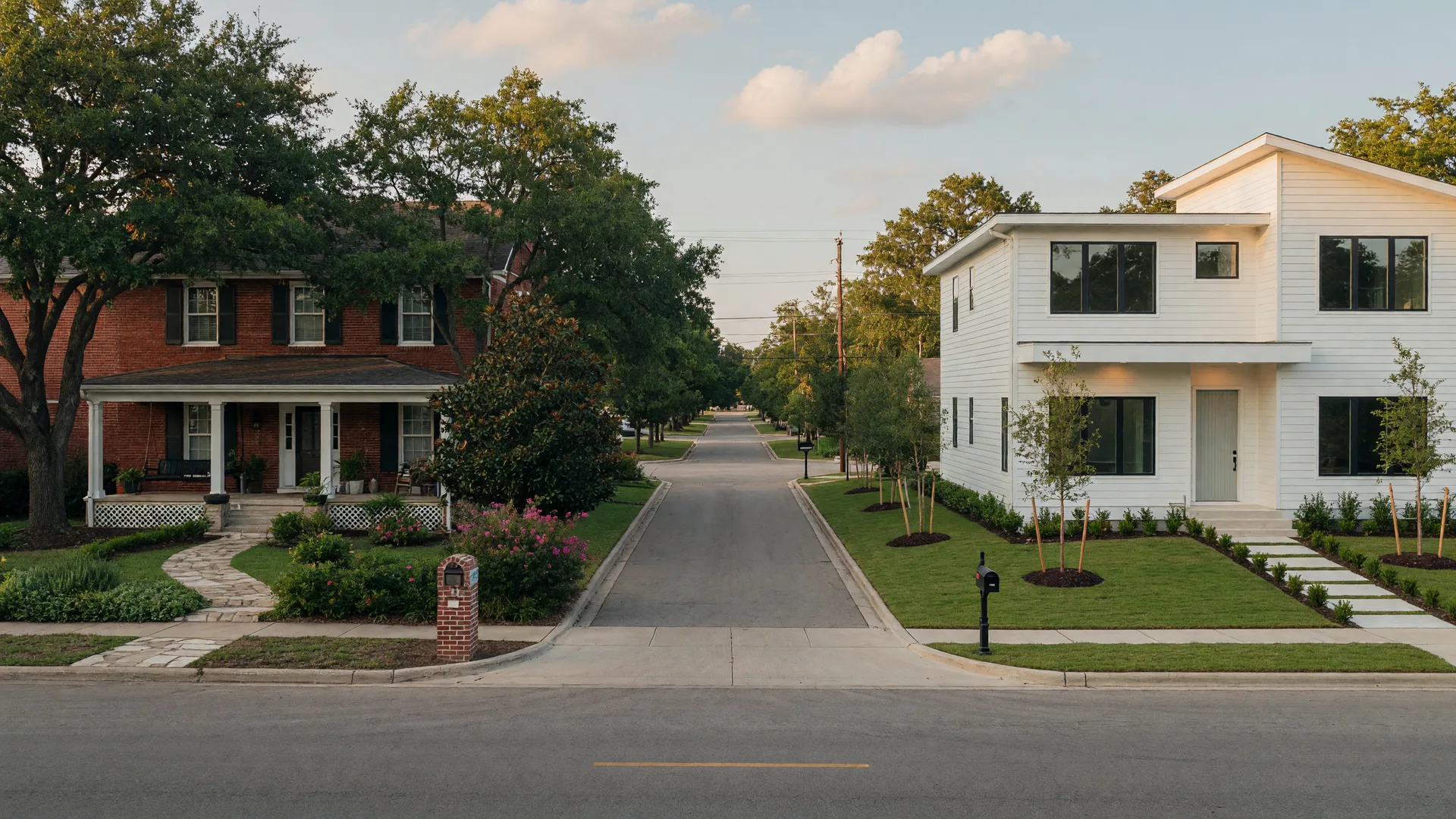
3. New build vs resale: customization vs certainty
New construction gives you a home nobody has lived in, choices at the design center, builder warranties (commonly 1-year workmanship, 2-year systems, 10-year structural in Texas), and modern energy efficiency. It also means a 4 to 9 month build timeline, a builder's contract that favors the builder, potential MUD taxes in new communities, and a final price that creeps up with every upgrade.
Resale gets you an established neighborhood, mature trees, a school district history, and terms that are genuinely negotiable, with a standard 30 to 45 day contract-to-close. You give up customization, and you take on the age of the systems, the inspection surprises, and whatever the previous owners deferred. Neither choice is objectively better; the numbers live in the specific home and community.
My new build vs resale comparison covers the hidden trade-offs in detail, and the new construction process guide explains builder pricing, incentives, and contract terms.
4. Using a real estate agent: what you actually get
The common misconception is that buyers pay for their agent. In most Texas resale transactions, the seller pays the buyer's agent compensation through the closing proceeds, which means strong representation usually costs the buyer nothing out of pocket while protecting their interests. What an agent actually does: price the offer against comps, negotiate terms within the option period, coordinate inspections and title, and keep every deadline.
The counterpoint is honest: an underperforming agent adds little, and in private-sale and for-sale-by-owner situations the seller may not offer buyer-agent compensation, so ask how their fee would be handled before you tour. And no agent replaces your own research: you should still check schools, commutes, and neighborhoods yourself.
My angle is specific: I am dual licensed, both a real estate agent and a loan officer. That means the person negotiating your contract also understands exactly what your financing can support, whether a concession fits your loan program, and how any counteroffer changes your cash to close. It is a structure few buyers get to combine, and I built my practice around it. You can read more about my background here.
The decision framework I give every buyer: stay 5-plus years and can afford the cash-to-close? Buy. Holding 5 to 7 years and comfortable with resets? Consider the ARM. Want it now with negotiable terms and no surprises? Resale. Want it your way and can wait out the build? New construction. The right answers come from your numbers, not from fashion.
Frequently Asked Questions
Is it better to rent or buy right now? Tap to expand
When does an adjustable-rate mortgage make sense? Tap to expand
Should I buy new construction or an existing home? Tap to expand
Is a real estate agent worth it for buyers? Tap to expand
How do I know which decision is right for me? Tap to expand
Continue Your Home Buying Education
Deeper dives into each of the decisions above.
Not sure which way these decisions point for you?
Bring me your situation and I will run all four options against your actual numbers: rent vs buy, fixed vs ARM, new build vs resale, with and without an agent's representation. The answer will be on paper, not in a slogan.
About Patrick Kevin Fagan, REALTOR®
Patrick Kevin Fagan is a Texas Real Estate Sales Agent (#454749) with AXEN Realty LLC and a Senior Loan Officer (NMLS ID #877741) with NEXA Mortgage, LLC (NMLS #1660690). He brings 23+ years in mortgage lending and 19 years in real estate, serving homebuyers, homeowners, and sellers across Greater San Antonio and the Texas Hill Country.
Answered by Patrick Kevin Fagan
Texas Real Estate Sales Agent #454749, AXEN Realty LLC · Senior Loan Officer, NMLS ID #877741, NEXA Mortgage, LLC
Call or text: 210-317-6514
