
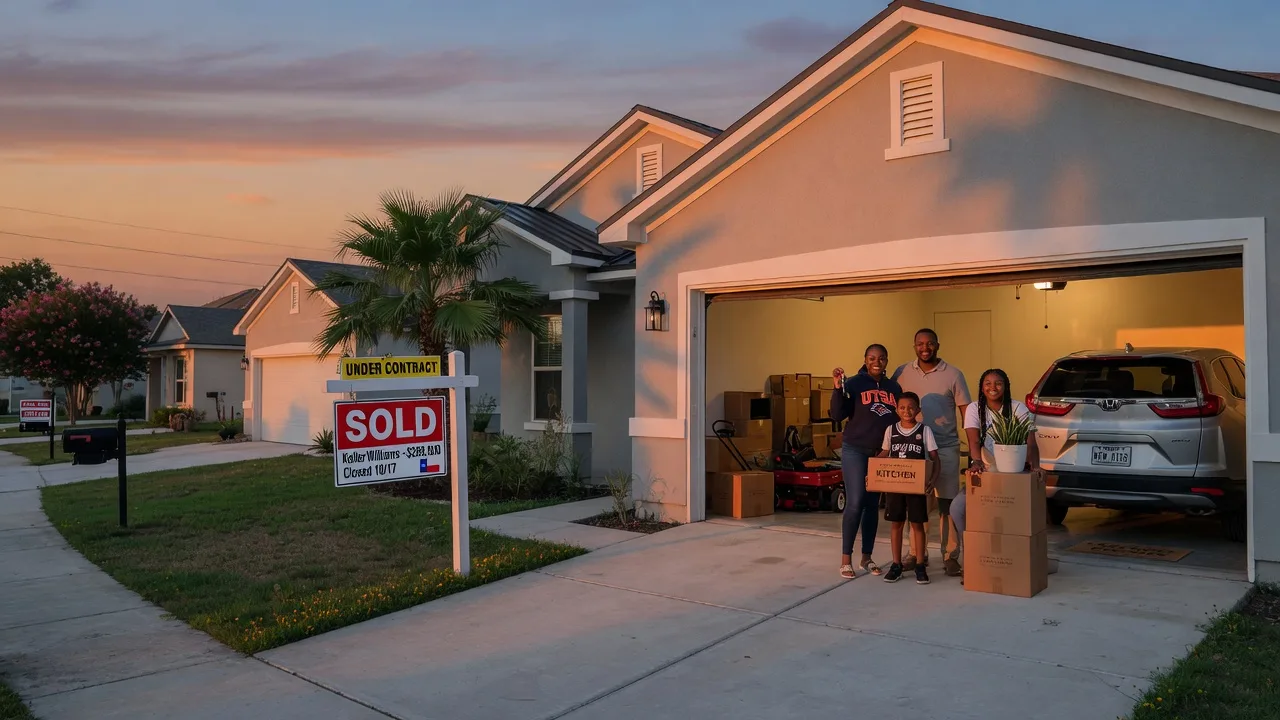
Patrick's Quick Answer
On an $80,000 to $120,000 income, the home you can afford depends on your debts, your down payment, and today's rates. As a rule of thumb, pre-approval lands near three to four times your annual income before Texas taxes and insurance. I run the full payment math, including taxes and insurance, so you know the real number before you tour.
Patriot Nation, good to have you back. Simple question today: how much house can you afford in 2026? That is usually the most basic question first-time home buyers or even second-time home buyers have. Given your household makes $80,000 a year or $100,000 or even $120,000, how much house can you control if you go out into the marketplace and try to buy a home? We are going to solve for that riddle today.
I am going to show you the very simple calculation that goes into it. And I will also share something with you if you want to receive it: a weekly little flyer that at a glance tells you how much house you can buy given your credit scores, your debt load, and of course your income level. That will be a great help to you, I hope.
If you want to understand how lenders figure out how much house you can afford, I cover the basics in my Ask Patrick answer.
So watch this all the way through, and let us jump on this rodeo.

Prefer to watch? Patrick breaks down the numbers in this video.
The Core Question: How Much House Can You Afford?
Hi folks, I am the Mortgage Patriot, Patrick Kevin Fagan, on your side, nestled here in the Hill Country above San Antonio, Texas, serving all you proud Texans and great folks all around the country. Another great video today because we are going to talk about how much house you can buy given your income level. If you make $80,000, $100,000, $120,000, how much house can you actually buy right now in 2026 given where the interest rates are today?
Let us get into this analysis. It is very simple actually, and you can play along at home as I say. Here is what you do: take your annual income (this does not include side hustles you get paid in cash, just legitimate reportable IRS-related income). Take your yearly income, divide it by 12 to get a monthly figure, and then take that monthly figure and multiply it by 38.
The Simple Formula: Annual Income to Monthly Payment
Here is the formula in plain English:
Annual Income ÷ 12 = Monthly Income
Monthly Income × 38% = Max Housing Payment
Why 38%?
Why 38? Because that is what FHA and conventional loans, which you would probably start out with as a first-time home buyer, allow. They allow about 38% of your monthly income to be contained in your housing payment.
Now, your housing payment is going to be like five different things combined. We will break those down next.
What Goes Into Your Housing Payment
Your housing payment is made up of five different factors combined. All five go into your full housing payment, and that cannot exceed that 38% of your income:
Principal & Interest
Your loan payment
Property Taxes
Varies by county
Property Insurance
Required by lender
HOA Dues
If applicable
Mortgage Insurance
PMI or MIP
All five of these factors combined make up your total housing payment, and that needs to fit inside that 38% cap.
The Back-End Ratio: Your Total Debt Picture
Now there is a second ratio, called the back-end ratio. Not your housing ratio, but all your other debts. That is your consumer debt: your credit cards, student loans, auto loan payments, and any other installment loans on your credit report.
Your combined housing payment plus your back-end consumer debt, on an FHA or conventional loan, can be about 54%. So when you take your monthly income and multiply by 0.54, that is the total debt you can carry. Subtract your housing payment from that, and what is left over is how much additional consumer debt you are allowed to have.
Monthly Income × 54% = Max Total Debt
Minus Housing Payment = Room for Consumer Debt
Worked Example: $96,000 Per Year
Let us put numbers to all this so it makes sense. Let us say you are making $96,000 a year.
Step-by-Step: $96,000 Annual Income
That $1,280 residual means that is how much you can have roughly in terms of consumer debt. Your auto payments, credit cards, student loans, other installment debt. If it exceeds that amount, you likely will not qualify for that payment because you have exceeded your ratio. Hopefully all this makes sense.
This is all great, Patrick Kevin Fagan. Now tell me how much house I could buy at $96,000 a year, $8,000 a month.
Real Example: $375,000 Purchase Price
Remember, your maximum payment is going to be about $3,040 based on that 38% ratio. So how much house gets you a $3,040 payment?
You can punch numbers into a mortgage calculator. I put in a $375,000 purchase price, 3.5% down on an FHA loan, at a current rate of about 5.75%. That is kind of where we are in the market now. Rates have come down below 6%. It is nice.
I made estimations for property taxes at 1.6%, insurance around 0.7%, $50 per month for HOA dues, and PMI factor at 0.55%. All that combined came to a payment of about $3,012 to $3,120.
At $96,000 per year, you can afford roughly a $375,000 home in Texas
FHA with 3.5% down at ~5.75% · Property tax 1.6% · Insurance 0.7% · HOA $50 · PMI 0.55%
Estimated Monthly Payment Breakdown
These are illustrative estimates based on current market conditions. Your actual numbers will vary.
Every situation is going to be different depending on your state, depending on your county-level property taxes, depending on what the interest rates are at the time. But hopefully this gives you a good estimate.
Texas-Specific Factors That Change the Numbers
If you are buying in Texas, a few things make the math different from other states:
County-Level Property Taxes
Texas has no state income tax, but property taxes are higher than most states. Rates vary significantly by county, typically 1.6% to 1.85%. Bexar County (San Antonio) is on the lower end, while some counties run higher. Always check the exact rate for the property you are considering.
Texas Insurance Rates
Homeowners insurance in Texas tends to run higher than the national average due to weather exposure. Shopping around for insurance can save you real money each month. Many carriers offer bundling discounts with auto insurance.
HOA Prevalence
Many newer subdivisions in San Antonio and the Hill Country have HOA fees that range from $35 to $150 per month. This is part of your housing payment and counts toward your 38% ratio. If you want to avoid HOA dues, look for homes in established neighborhoods or rural areas that do not have an HOA.
Credit Scores, Down Payments, and the Four Key Numbers That Change Your Buying Power
Patriot Nation, the 38% formula gets you in the ballpark, but there is more to the picture. The loan type you choose, your credit scores, your down payment, and where you live all shift the final numbers. Here are four things every buyer needs to understand to get the most buying power possible.
1. Credit Score Minimums by Loan Type
Your credit score drives your interest rate, and your rate drives your monthly payment. That is why improving your credit scores is the single easiest way to improve your affordability. Each loan type has a minimum threshold you have to meet:
FHA
580
Minimum credit score. You will qualify for better pricing the higher you go above this.
Conventional
620
Minimum credit score. Above 740 gets you the best rates on the market.
VA
600
For veterans and active military. No down payment required.
USDA
600-620
Rural areas only. Zero down payment, but the property must be in a USDA-eligible zone.
If your scores need work, I have helped many buyers move their numbers in just a few months. There are specific action steps that make a real difference. Improving your scores even 20 to 30 points can save you thousands over the life of your loan.
2. Down Payment Minimums by Loan Type
How much you put down affects both your loan amount and the rate your lender offers you. More down means you are borrowing less, and the lender sees you as a lower risk, which usually means better pricing. Here are the minimum down payment requirements for each program:
| Loan Type | Min Down Payment | Notes |
|---|---|---|
| FHA | 3.5% | Most popular first-time buyer program |
| Conventional | 5% | Can go to 3% if income is under 80% area median income |
| USDA | 0% | Rural areas only, income limits apply |
| VA | 0% | Veterans, active duty, and qualifying spouses |
Higher down payments generally get you better pricing from the lender. Even putting 10% instead of 5% can lower your rate.
3. Property Tax Rates Vary Widely by State
Property taxes are one of the five components in your housing payment, and they can vary dramatically depending on where you buy. Here is a rough comparison of effective property tax rates across different states so you can see how location changes the math:
| State / Region | Typical Rate | Impact on $375K Home |
|---|---|---|
| Texas | ~1.85% | ~$578 / month |
| California | ~1.3-1.5% | ~$438 / month |
| Arizona | ~1.1-1.2% | ~$359 / month |
| Florida | ~1.1-1.2% | ~$359 / month |
| Northeast (e.g. NY, NJ, CT) | 2%+ | ~$625+ / month |
Rates vary by county, not just by state. The best way to get exact numbers is to check your County Appraisal District for the specific property you are looking at.
4. Conventional Loans Have a Tighter Back-End Cap
Here is something a lot of buyers do not realize until they start shopping: a conventional loan has a tighter back-end ratio than FHA. FHA allows your total debt (housing plus consumer debt) to go up to about 54% of your monthly income. But conventional loans cap that total at 49.99%. That is just under 50%.
Conventional Loans: 49.99% Total Debt Cap
That 49.99% number is important. If your car payment, credit cards, and student loans plus your housing payment push your total debt past that 50% mark, a conventional loan will not work for you. You would either need to lower your consumer debt or switch to an FHA loan, which allows the higher 54% cap. This is why I always run the numbers both ways for my clients. Knowing these limits upfront saves you from getting halfway through the process and finding out the loan type you picked does not fit your debt picture.
The takeaway is simple: know your debt load before you pick a loan program. FHA is more forgiving on the back end. Conventional often has better rates and lower monthly mortgage insurance, but it is more strict on total debt. As a dual licensed loan officer and realtor, I help my clients pick the right program for their specific situation.
Quick Reference: $80K, $100K, $120K Income Levels
Here is where each income level lands in today's Texas market, assuming moderate debt load, a 700+ credit score, and FHA financing with 3.5% down:
| Annual Income | Monthly Income | Max Housing (38%) | Approx. Home Price |
|---|---|---|---|
| $80,000 | $6,667 | $2,533 | ~$310K |
| $100,000 | $8,333 | $3,167 | ~$395K |
| $120,000 | $10,000 | $3,800 | ~$470K |
Estimates assume 3.5% down FHA at ~5.75%, Texas property tax ~1.6%, insurance ~0.7%, HOA $50, PMI 0.55%, moderate debt load, 700+ credit score. Your numbers will differ. Always get a personalized pre-approval.
Get the Weekly Affordability Flyer
Here is something I want to send you. I will send you on a weekly basis this how-much-house-can-you-buy-today flyer, given where FHA rates are at any point in time and given your circumstances.
It gives you three variables. It covers $80,000 income, $100,000 income, and $120,000 income. If you are somewhere in there, you can kind of extrapolate if you are in between. At $100,000 on this chart, if you have a 700 to 720 credit score and maximum consumer debt of about $1,300 per month, you can afford to buy today a $395,000 home. That is how you read this chart. You look at the flyer, run your finger across where your income level is, what your credit scores are, how much debt you have, and it will tell you roughly how much house you can afford today.
Want this weekly flyer?
Fill out a quick form with your name and email and I will send it to you every week. No strings attached. Just a helpful resource to keep your numbers current.
Get the Weekly FlyerHow to Increase Your Buying Power
There are real strategies to increase how much home you can buy without needing a higher income:
- Pay down consumer debt. Every dollar of monthly debt you eliminate frees up buying power. Paying off a $300 car payment can increase your affordable home price by tens of thousands of dollars.
- Improve your credit score. Even a 20- to 30-point bump can lower your rate enough to save $50 to $80 per month. Check out these credit hacks for specific strategies.
- Use down payment assistance. Texas has programs through TDHCA and TSAHC that can cover part or all of your down payment and closing costs. Check out Texas DPA programs to see what you qualify for.
- Look for seller concessions. You can negotiate for the seller to pay a portion of your closing costs. On FHA loans, sellers can contribute up to 6% of the purchase price toward your costs. That could cover most of your transaction costs and prepaids.
- Explore different loan programs. FHA vs conventional makes a real difference. See the loan comparison guide for the breakdown. And consider ways to lower your mortgage payment beyond just the rate.
Patrick's Take: Know Your Numbers, Buy With Confidence
The formulas lenders use are not a secret. I want every buyer to understand how their income, debt, and credit score all come together to produce a number. That number is not a ceiling to be afraid of. It is a tool to help you make smart decisions.
When you work with me, you get someone who understands both sides of the transaction: the real estate agent side that negotiates the offer, and the loan officer side that structures the financing. Being dual licensed means I can help you structure offers that get accepted and minimize your cash-to-close. My goal is to assist families in starting the path toward homeownership and be a part of their wealth building and independence journey.
Frequently Asked Questions
How much house can I afford if I make $80,000 a year?
How much house can I afford at $100,000 a year?
How much house at $120,000 a year?
What is the 38% rule lenders use?
What is the back-end ratio and why does it matter?
How do property taxes in Texas affect my buying power?
Continue Your Home Buying Education
Explore more resources to deepen your knowledge and build your confidence.
Complete Home Buyer's Roadmap
Step-by-step from start to close
5 Ways to Lower Your Payment
Beyond just the interest rate
FHA vs Conventional Loans
Which loan is right for you?
Credit Score Hacks
Boost your score before applying
Texas DPA Programs
Down payment assistance options
VA Home Buying Guide
For military families and veterans
Ready for Personalized Numbers?
I can figure out your exact payments and how much house you can really afford. If you have any more complicated questions, I am here for that too. Let us work together.
About Patrick Kevin Fagan, REALTOR®
Patrick Kevin Fagan is a Texas Real Estate Sales Agent (#454749) with AXEN Realty LLC and a Senior Loan Officer (NMLS ID #877741) with NEXA Mortgage, LLC (NMLS #1660690). He brings 23+ years in mortgage lending and 19 years in real estate, serving homebuyers, homeowners, and sellers across Greater San Antonio and the Texas Hill Country.
Answered by Patrick Kevin Fagan
Texas Real Estate Sales Agent #454749, AXEN Realty LLC · Senior Loan Officer, NMLS ID #877741, NEXA Mortgage, LLC
Call or text: 210-317-6514