
PATRICK'S QUICK ANSWER
The process is builder-controlled from day one: you sign the builder's contract, not the state resale form, pick upgrades in a design center, and wait 4 to 9 months for keys. Three decisions drive your outcome: get pre-approved before you tour, budget against the finished price plus lot and upgrades, and lock a rate that can survive a slipping timeline. Incentives are real but buried in fine print. Nail those three and the process goes from intimidating to manageable.
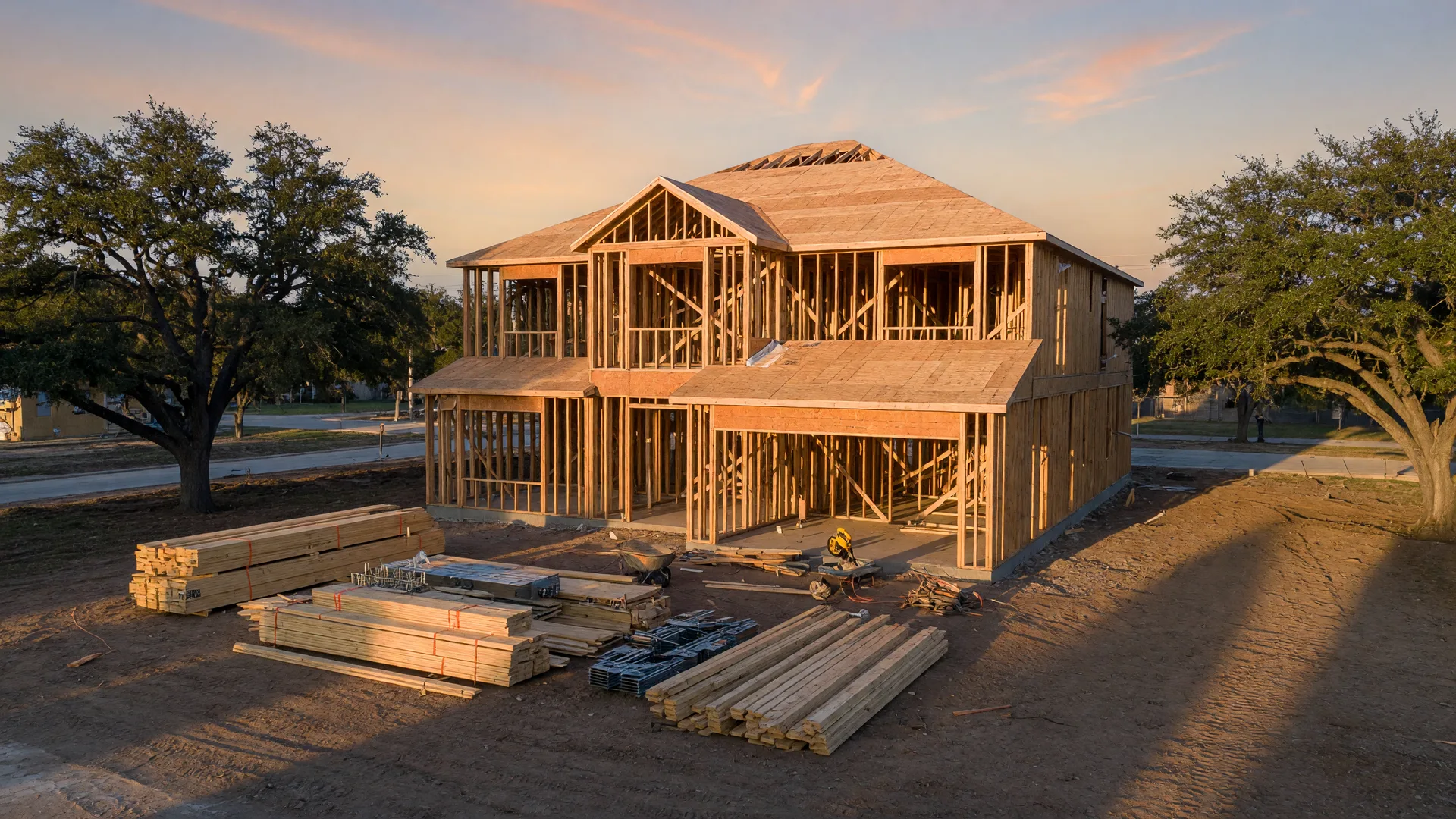
Buying a newly built home in Texas is a different process from buying resale: you sign the builder's contract instead of a TREC resale form, choose finishes in a design center, and typically wait 4 to 9 months from contract to keys, with a few planned walkthroughs along the way. The payoff is a home nobody has lived in, builder warranties, and, in many communities, incentives worth real money. The risk is in the details: base pricing that excludes lot and upgrades, builder financing tie-ins, and timelines that slip. Here is the full process with the numbers you need.
Before you tour model homes anywhere, get financing in order. My San Antonio new construction guide covers the communities and builders, and the new build vs resale comparison helps you decide which route fits.

Watch on YouTube
New Construction Homes: How to Negotiate Builder Deals & Save $22,000+
Patrick breaks down builder negotiation: incentives, credits, and the line items where builders give ground.
Watch the videoMore videos on The Mortgage Patriot channel.
1. The process, step by step, with realistic timing
- Get pre-approved first (1 to 2 weeks). Builders and communities require proof of financing before you can reserve a lot or sign. A pre-approval also fixes your budget before the design center tempts you.
- Tour and compare (2 to 6 weeks). Visit model homes, check floor plans, lot prices, schools, commute times, HOA fees, and any special taxing districts like a MUD. Communities across Schertz, Cibolo, New Braunfels, Boerne, and the Stone Oak area all have different price points and tax situations.
- Pick the lot and sign (1 to 2 weeks). You sign the builder's purchase agreement, pay earnest money (builders commonly ask for $1,000 to $5,000 or more), and the lot is yours. Read the contract carefully; it is not the TREC resale form.
- Design center selections (1 to 4 weeks). You choose flooring, countertops, cabinets, fixtures, and often structural options. Every choice has a price, and the base price is rarely the final price.
- Construction (typically 4 to 9 months). Production builders complete a home in roughly 4 to 6 months; semi-custom and custom builds run longer. You should get milestone visits: pre-pour, framing, pre-drywall, and a pre-closing walkthrough.
- Final walkthrough and closing (1 to 2 weeks after completion). You inspect the finished home, note defects for the warranty punch list, and close at the title company, usually 30 to 45 days after the certificate of occupancy.
2. How builders price homes: base, lot, and upgrades
The advertised base price covers a specific floor plan with standard finishes. Three things move the final number: the lot premium (corner, greenbelt, or larger lots cost more), structural options (extra bedrooms, extended patios, floor plan changes), and design center upgrades. As general guidance, buyers who make meaningful upgrades often add 5% to 15% to the base price, and some communities add more. The builder's sales representative should give you an "all-in" estimate including lot and the upgrades you select before you sign.
Also confirm what is included and what is not. Landscaping, fences, sprinklers, window coverings, appliances, and garage door openers vary by builder and community. A $330,000 base price with $20,000 of excluded standard items is a different deal than one with everything included.
3. The builder's contract: not your usual Texas contract
New construction uses the builder's own purchase agreement, not the TREC One to Four Family Residential Contract. A few things to read closely:
- Earnest money and deposit timing. Builders often ask for a deposit at contract, and may require it to increase at milestones like slab pour or drywall.
- Cancellation terms. What happens if you cancel, and what happens if the builder cancels. Know whether your deposit is refundable and under what conditions.
- Change orders. Every change after contract means a written change order with a price. Unauthorized changes can void the contract, so never ask trades to add work directly.
- Delivery date. Many builder contracts state an estimated completion date, not a guaranteed one, and may limit your remedies for delays. Ask how delays are handled and what happens if your financing rate lock expires during the build.
- Dispute resolution. Arbitration clauses are common. Know what you are agreeing to.
My contract terms guide covers protections that matter in any purchase, and the offers and negotiation guide shows how concessions work in both resale and new construction.
4. Incentives: where the real savings live
Builders routinely offer incentives to move inventory, especially in slower months and on completed "spec" homes. The common ones:
- Closing cost credits. A dollar credit applied at closing, often $5,000 to $15,000 on mid-priced homes depending on the builder, community, and timing. On a $380,000 home, a $10,000 credit roughly covers title, lender fees, and a big share of prepaids.
- Interest rate buydowns. Builders often pay for a temporary 2-1 or 3-2-1 buydown, lowering your payment in the first two or three years. See my buydown guide for how the math works.
- Upgrade credits. Free money at the design center, e.g., "$10,000 in upgrades included." It is real value only if you would have spent that anyway.
- Appliance or landscaping packages. Occasionally bundled or restricted to the builder's vendors.
The catch: many incentives are conditional on using the builder's preferred lender. That financing can be competitive, but you should still compare the full picture: rate, points, fees, and the incentive. Sometimes the builder's lender wins, sometimes your own lender wins even after losing the incentive. Compare apples to apples with actual loan estimates before deciding. As a loan officer myself, I will run that comparison with you line by line. For the current, verified incentive offers by community, see the San Antonio Builder Incentives, Decoded guide.
5. The design center: spend with a plan
The design center is where budgets go to die, so set a total upgrade budget before you walk in, typically 5% to 15% of base price for meaningful upgrades. Prioritize the things that are expensive to change later: flooring, countertops, cabinets, and structural options. Defer the things you can replace cheaply later: lighting fixtures, faucets, and some appliances.
Every upgrade is financed into your mortgage over 30 years, so a $10,000 upgrade costs more than $10,000: at a 6.5% rate on a 30-year loan, it adds roughly $63 a month in principal and interest plus taxes and insurance. Cheap monthly now, expensive later if you did not plan it.
6. Texas-specific things to research before you buy new
- MUDs and special taxing districts. Many newer Texas communities sit in Municipal Utility Districts or special districts that impose extra property taxes to pay for roads and water. Ask for the tax rate history and a projection of your total property tax bill, not just the city rate.
- HOA fees and rules. Common in new communities. Read the covenants for restrictions on fencing, landscaping, parking, and short-term rentals if those matter to you.
- School districts. A new address can change school assignment, and some districts are crowded in fast-growing areas. Confirm enrollment and any transfer options before you sign.
- Warranties. Texas builders commonly provide a 1-year workmanship, 2-year systems, and 10-year structural warranty. You cannot waive the implied warranties under Texas law, but read the fine print on your builder's warranty and keep your walkthrough punch list strict.
- Appraisal reality. New construction can appraise below the contract price if upgrades and lot premiums exceed what recent sales support. That is exactly why comparable sales in the same community matter, and why financing structure should be decided early.
7. Financing a new build: rate locks and long timelines
The build timeline means your rate lock has to stretch. Standard locks run 30 to 60 days; builders often arrange longer locks of 6 to 12 months through their preferred lenders, sometimes at a small cost or tied to their incentive package. If you lock with your own lender, watch the lock expiration against the estimated completion date, and ask what happens if the build runs late: extension fees are common.
One more financing note: with a purchase contract in hand you can usually lock a rate early, and some buyers choose a floating approach if rates are falling. There is no free lunch either way, but a clear plan beats hoping. I handle new construction financing regularly across Bexar County and the Hill Country, and I will walk you through the lock strategy that matches your build date.
Questions to ask before you sign with any builder: What is the all-in price with lot and the upgrades I picked? What is included versus excluded? What happens to my deposit if the completion date slips? What does the warranty actually cover? Which incentives require their lender, and what are their rate and fees versus mine?
Frequently Asked Questions
How long does it take to build a new home in Texas? Tap to expand
Are new construction incentives worth using the builder's lender? Tap to expand
Can I negotiate the price of a new construction home? Tap to expand
What are MUD taxes on new construction homes? Tap to expand
Should I hire my own inspector for a new build? Tap to expand
Continue Your Home Buying Education
More resources from Patrick on new construction and buying strategy.
Buying new construction? Get the financing and the offer plan aligned first.
I structure new construction financing around your build timeline, compare builder-lender incentives honestly, and make sure your contract numbers match your loan numbers before you sign.
About Patrick Kevin Fagan, REALTOR®
Patrick Kevin Fagan is a Texas Real Estate Sales Agent (#454749) with AXEN Realty LLC and a Senior Loan Officer (NMLS ID #877741) with NEXA Mortgage, LLC (NMLS #1660690). He brings 23+ years in mortgage lending and 19 years in real estate, serving homebuyers, homeowners, and sellers across Greater San Antonio and the Texas Hill Country.
Answered by Patrick Kevin Fagan
Texas Real Estate Sales Agent #454749, AXEN Realty LLC · Senior Loan Officer, NMLS ID #877741, NEXA Mortgage, LLC
Call or text: 210-317-6514