
The buyers who want no part of FHA's lifetime mortgage insurance still hit the same wall as everyone else: the down payment. Conventional loans come with better long-term math and steeper upfront cost, and the question is whether down payment assistance can bridge that gap without ruining the deal. It can, with caveats. Here is how conventional plus DPA stacks up, where it beats FHA, and the honest monthly math.
Quick Answer
Yes, Texas DPA pairs with eligible conventional loans when the program and the investor allow the second lien. Conventional wants at least 620 and 5% down (3% for first-time buyers), while most DPA programs want credit around 640, so the DPA gate usually governs. The second lien carries its own payment alongside conventional mortgage insurance, and the total monthly cost is what picks the winner.
Get help lowering your cash to close with DPA on a conventional loan.
Yes, it can: with the conventional caveats
Down payment assistance works on conventional loans in Texas, and the state's big programs are built for it: TDHCA and TSAHC products list conventional structures like Fannie Mae HFA Preferred and Freddie Mac HFA Advantage as eligible first mortgages, with DPA layered on top.
The caveats are real. Conventional's standard entry is 5% down, with 3% options for first-time buyers, and the DPA second lien has to satisfy both the assistance program and the investor who buys the loan, because investors set rules on subordinate financing. Not every DPA program works with every conventional product, which is why the pairing gets confirmed in underwriting, never assumed at the open house.
The credit stack: 620 conventional, around 640 DPA
Two credit gates stack again, and the second one is taller. Conventional lending wants a minimum around 620, and that is the number most buyers quote from memory. The DPA program then adds its own requirement, commonly around 640, and on several Texas programs the conventional tier is the one that asks for the higher score.
Real-world consequence: a 625 buyer can qualify for the conventional loan and miss the assistance, then watch the same house work on FHA where the DPA door opens lower. The score the program wants, not the score the loan wants, is the score that decides whether this pairing is even on the table.
The money trade: PMI that cancels vs a second lien with its own payment
Conventional brings its own insurance: put less than 20% down and mortgage insurance rides in the payment until you build 20% equity, at which point it goes away on its own. That is the big long-term advantage over FHA, whose mortgage insurance does not simply drop off as equity grows.
The trade is the second lien. A conventional DPA second lien still carries its own payment, commonly around $80 a month, and unlike the insurance, that payment does not disappear at 20% equity. It is a separate obligation with a separate repayment path, forgiven, deferred, or paid monthly depending on the program.
Dollar math: the honest comparison lines up three costs, the first-mortgage payment, the mortgage insurance, and the second-lien payment, against the same stack on FHA. The headline rate tells you nothing; the total monthly check tells you everything.
The limits: the same income and price caps
Conventional plus DPA does not escape the gate that comes with every Texas program. The same county income limits apply, the same credit minimums, the same purchase-price caps, and the same location and occupancy rules. Choosing conventional over FHA changes the loan, not the assistance.
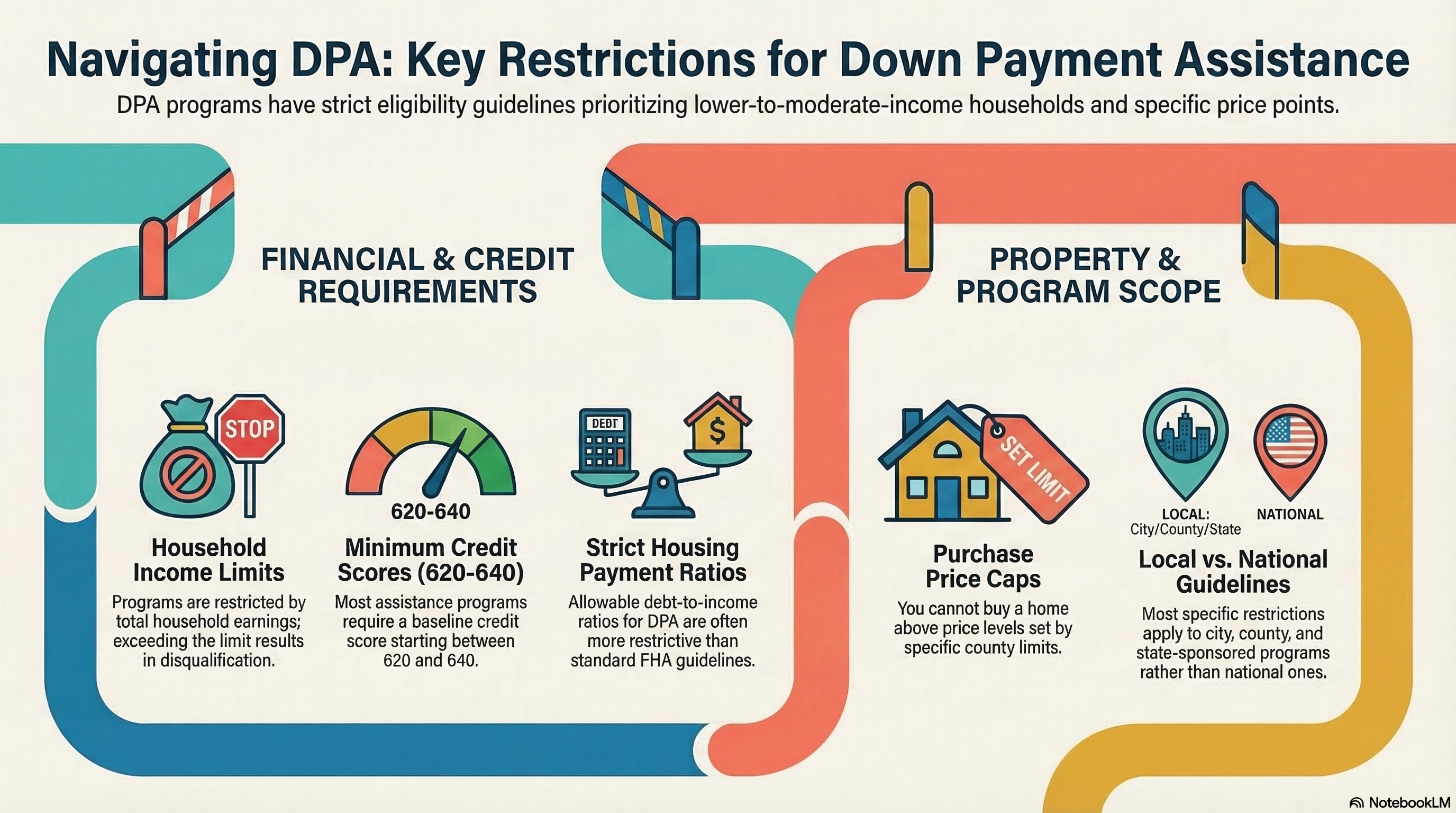
And the caveat about structure still stands: the investor who buys a conventional loan has rules about second liens, so the program and the loan product have to be compatible before the numbers mean anything.
Conventional plus DPA vs FHA plus DPA: when each wins
Run the two stacks side by side and the winner is decided by the all-in monthly payment, never the headline rate. Conventional plus DPA tends to win for the buyer with stronger credit, around 640 or better, who plans to stay put, because the mortgage insurance eventually cancels while FHA's stays behind. FHA plus DPA tends to win for the buyer with less cash and a lower score, because the door opens lower and the cash need is smallest.
The last word for buyers weighing the choice: get both quotes with the assistance attached, put the second-lien terms and the mortgage insurance into the same table, and let the monthly difference make the argument. The down payment help is the headline; the payment is the reality.
Ask Patrick about DPA with a conventional loan
Find out how to combine down payment assistance with a conventional loan in Texas.