
The DPA income limit is the least exciting sentence in home buying, and it sends more buyers further from homeownership than any credit score. You can have perfect credit, a clean contract, and cash in the bank, and one line of income on the income tax return can take the assistance off the table. Here is what AMI means, how your income gets counted, and what to do when you are over the line.
Quick Answer
Texas DPA income limits are set at the county level and measured against the county area median income. The typical qualifying gate for most programs is household income under about 80% of the county AMI, with USDA eligibility using a 115% figure in some tests and targeted areas reaching higher still. Go over the number, and the assistance is gone even with great credit.
Get help lowering your cash to close and checking DPA limits.
What AMI actually is
AMI stands for area median income, and the definition is simpler than the acronym: it is the midpoint of the income distribution for your region. Half the households around you earn more, half earn less. That single number is the ruler every program uses to decide who counts as a low or moderate income buyer.
Real-world consequence: AMI moves. It is published for metro areas and counties, and it updates, so the limit this year is not the same number as last year. A household that missed a program in one cycle can clear it in the next, which is exactly why the current table, not the number your cousin used two years ago, is the one that counts.
The typical gate: income under about 80% of county area median income
Program by program the gate has its own settings, but the shape is consistent: household income must sit under a percentage of the county AMI, and for most Texas programs the practical cutoff lands around 80%. Some programs reach higher, USDA eligibility uses a 115% figure in certain tests, and targeted areas can push the bar further up the income scale.
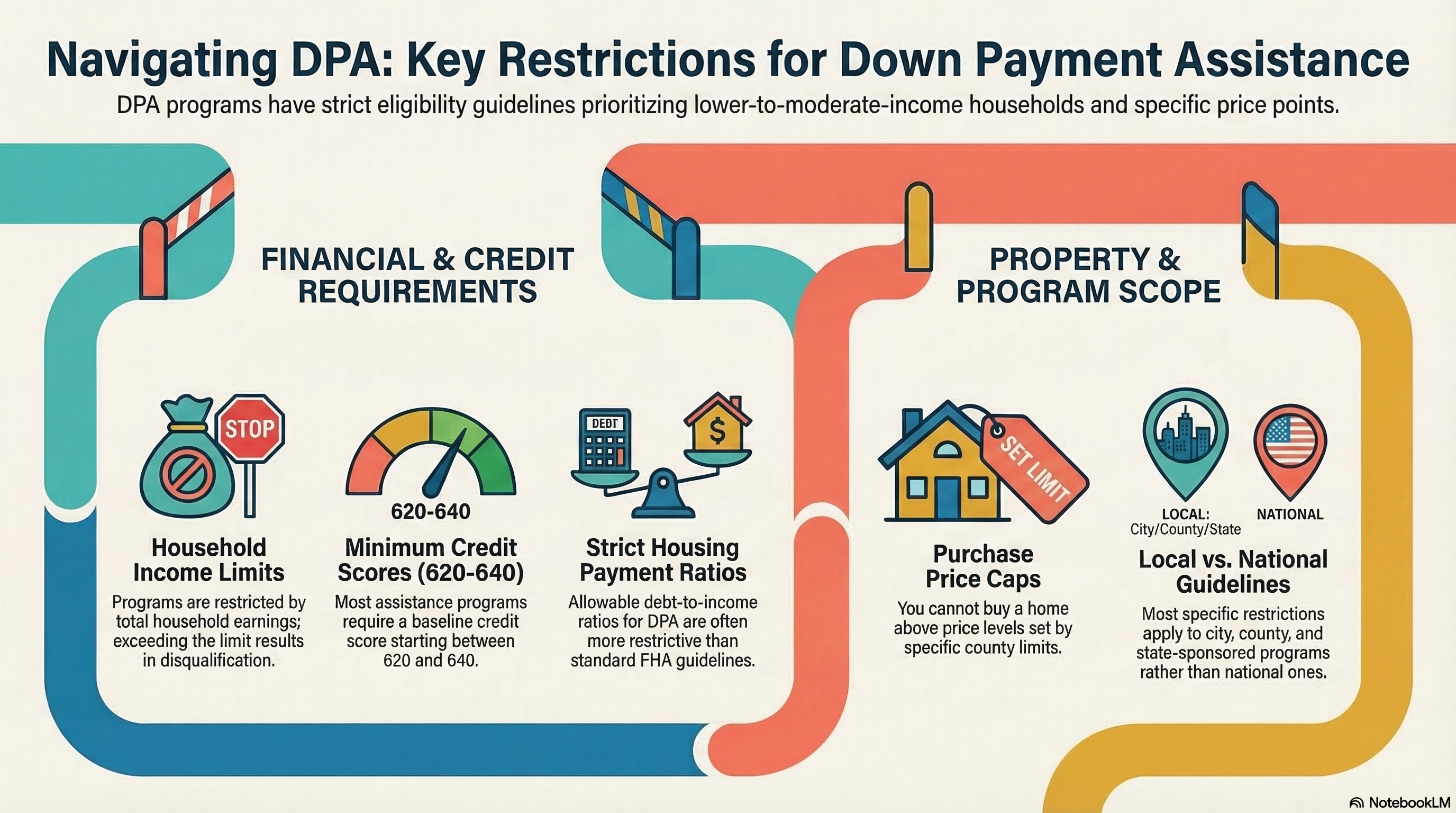
Dollar impact: for a San Antonio area household the difference between qualifying and not can be the difference between a closing that needs about $12,000 and one that needs roughly $3,000, because the same price home costs a very different amount with the assistance attached.
How your income gets counted
The second surprise is what counts as income, and the programs count households, not just the person signing the paperwork. Household income can include spouses, and some programs count everyone who signs the deed of trust, including a non-purchasing spouse. A second income in the household raises the household number even when that person is not even applying for the loan.
Real-world consequence: two incomes are often better news for the mortgage and worse news for the DPA program, and the same family can qualify on the loan file and miss the assistance, because the two rules use different income math. Run both numbers through the program table before building the plan around one of them.
Why the limits are county-based
The limits live at the county level, not the state level, and that one fact changes who qualifies. The income limit is attached to the county where the home sits, so a buyer can qualify in one county and miss in the next one over with the exact same income, credit, and price.
That is why the honest first question is never "should I use DPA?" It is "which county is this house in, and what does that county's table say?" The San Antonio area and the Hill Country are different markets with different numbers, and the price cap follows the county right alongside the income limit.
What happens if you go over the limit
Straight answer: you are disqualified from that assistance, and no amount of credit repair changes the result. A 780 score does not bend an income limit, because the limit is a program rule, not a lending standard.
Dollar impact: the consequence is not a penalty, it is the absence of the hand out. The buyer who was counting on $10,000 of assistance needs to find that money, or change the plan. That is why the income check belongs in the first conversation, not the week of closing.
What to do if you are over the limit
Over the line does not mean out of the game, it means a different game. The honest paths are the ones that do not need the assistance: skip the DPA and go straight to the low-down-payment programs, which is FHA at 3.5% down or a 3% conventional option for first-time buyers, and shrink the cash need with seller concessions toward closing.
And before you self-select out, check the other rows on the table: a targeted-area limit in your county can reach well above the standard number, and the household-size column changes the number too. The frequent ending is a buyer who "knows" they make too much, looking at a table that says otherwise and a program that fits.
Ask Patrick whether your income qualifies for DPA
Get a straight answer on Texas DPA income limits and which program you likely qualify for.