

A buyer reads that a program offers a "grant," and the brain immediately hears "free money." Then the Closing Disclosure shows a second mortgage with a payment attached, and the surprise lands in the monthly budget. The difference between a DPA grant and a DPA loan is thousands of dollars over the life of the deal, so here is how to tell them apart, what each one actually costs, and which one wins for which buyer.
Quick Answer
A true grant is free money that never gets repaid. A DPA loan is a second lien on the home: forgiven after enough years of living there, deferred until you sell, or repayable with a monthly payment of its own. The winner is the structure with the lower all-in monthly cost, not the one with the friendlier name.
Get help lowering your cash to close and choosing the right DPA.
The two flavors: a true grant never needs repayment
Start with the cleanest definition, because the industry blurs it on purpose. A true grant is money given to you with no repayment obligation attached. You buy the home, the money stays spent, and nobody ever sends a bill.
A DPA loan is a second mortgage on the home, recorded behind your first loan. It is a real lien with real terms, and it comes in three forms: forgiven after you live in the home long enough, deferred until you sell or refinance, or repayable with a monthly payment.
Dollar impact: the word "grant" carries extra value, since a $10,000 grant is $10,000 that never comes back. A $10,000 second lien is $10,000 that eventually needs an answer: forgiveness, a payoff at sale, or monthly installments.
How a DPA second lien works
When Texas assistance is a second lien, it behaves like a small second mortgage stacked on top of your first loan. Some are deferred, which means no monthly payment while you live there, and the balance waits until you sell, refinance, transfer, or pay off the first mortgage.
Some are repayable, with their own monthly payment. On a typical small second lien that payment runs around $80 a month. That number is real: it must be qualified for, it counts in your debt-to-income ratio, and it lands in your total monthly payment alongside the first mortgage.
Real-world consequence: the buyer who plans for the second lien budgets for it, qualifies for it, and knows the $80 a month is there. The buyer who ignores it discovers it in underwriting and either scrambles to fit the payment into a plan that was already set in stone.
What forgivable actually means
Forgivable is the middle ground, and it is the structure behind most Texas programs. The lien sits on the property as a second mortgage, but the balance is wiped out, meaning forgiven, after you meet the conditions: typically a set number of years of living in the home, commonly 3 to 5 years, while staying current on the first mortgage.
If you sell, refinance, or move out before the window closes, the forgiveness can be prorated or lost, and a balance you thought was gone comes back. If you stay for the full window, the lien is gone and the assistance acts exactly like a grant.
Dollar impact: a forgivable $10,000 lien on a buyer who stays 5 years is free money in the end. The same lien on a buyer who relocates in year two is a $10,000 bill at the closing table of the sale.
The money decision: free money vs a real payment
Here is where the name stops mattering. A grant may be free at closing but can come wrapped in a higher first-mortgage rate, because the program pays for the assistance somewhere. A second-lien loan carries a real payment but can come with a better rate on the first mortgage.
The buyer's job is one comparison: the all-in monthly cost of the grant program against the all-in monthly cost of the second-lien program, on the same house, same price, same day. A program that hands you $12,000 and quietly raises your rate can cost you more every month than a program that hands you $10,000 as a second lien and leaves the rate alone.
That is the math to run before you choose. Free money is only free if the full payment says so.
Which one wins: it depends on the program and the county
There is no national winner because there is no national program. Texas assistance is county-by-county and program-by-program. One county's best offer may be a true grant with a higher rate, the next county's may be a forgivable lien with a better rate, and a third may only offer a repayable second lien.
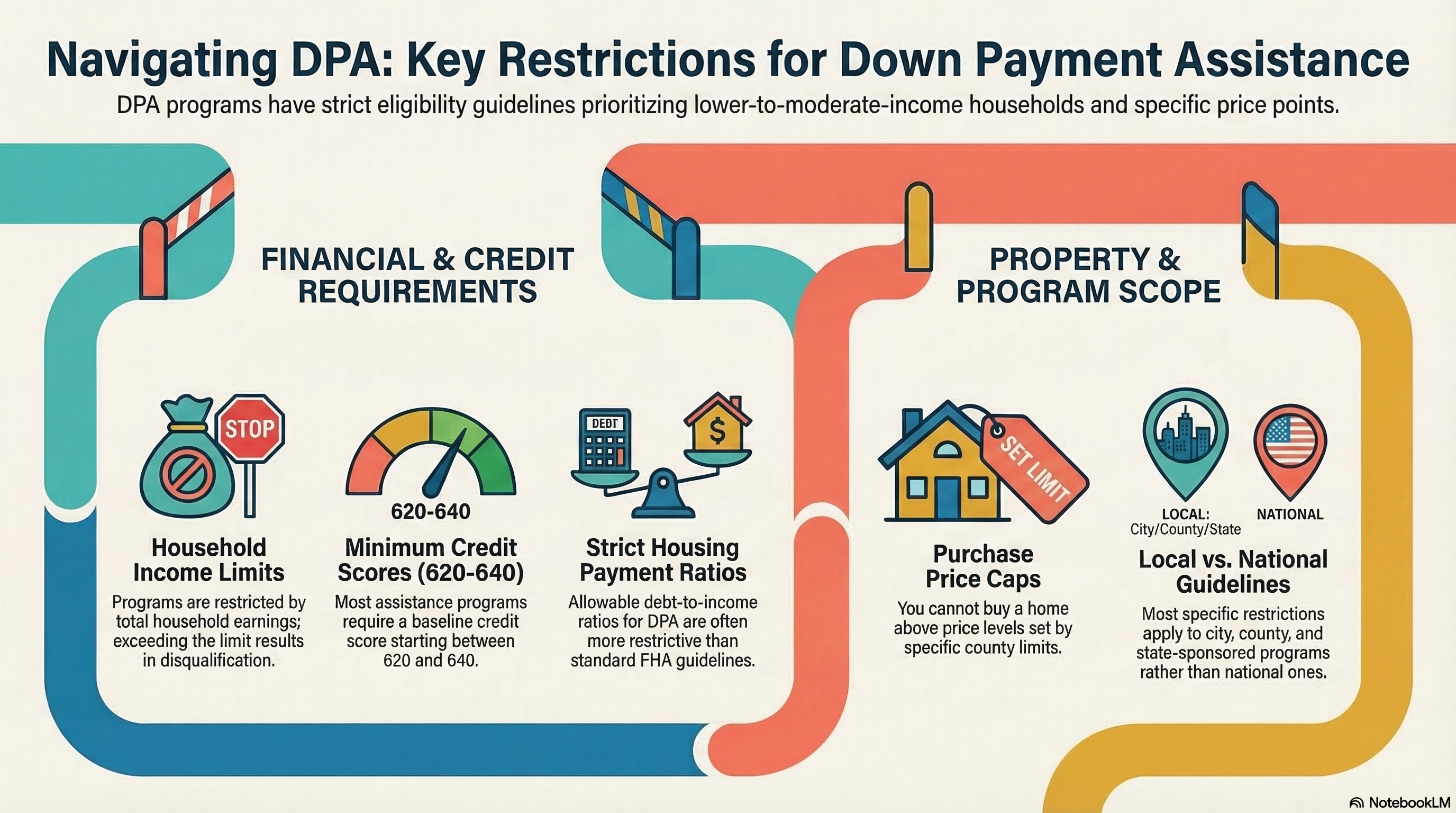
What holds everywhere: compare the repayment terms, the rate, the price cap, and the total monthly payment. And never accept "grant" at face value. Ask the loan officer for the structure in writing, then read what the program actually says before you build a budget on the word.
Ask Patrick about DPA grants vs DPA loans
Find out whether free-money grants or repayable DPA loans fit your situation best.