
PATRICK'S QUICK ANSWER
The Texas homestead exemption lowers your taxable value for school taxes, and you must file it with your county appraisal district, typically by April 30 for the current year. I weigh three things with clients: whether you filed, the deadline, and how it stacks with senior or disability breaks. It is free and takes minutes. File the day after you close and it pays you back every year. Ask Patrick how to claim the homestead exemption.
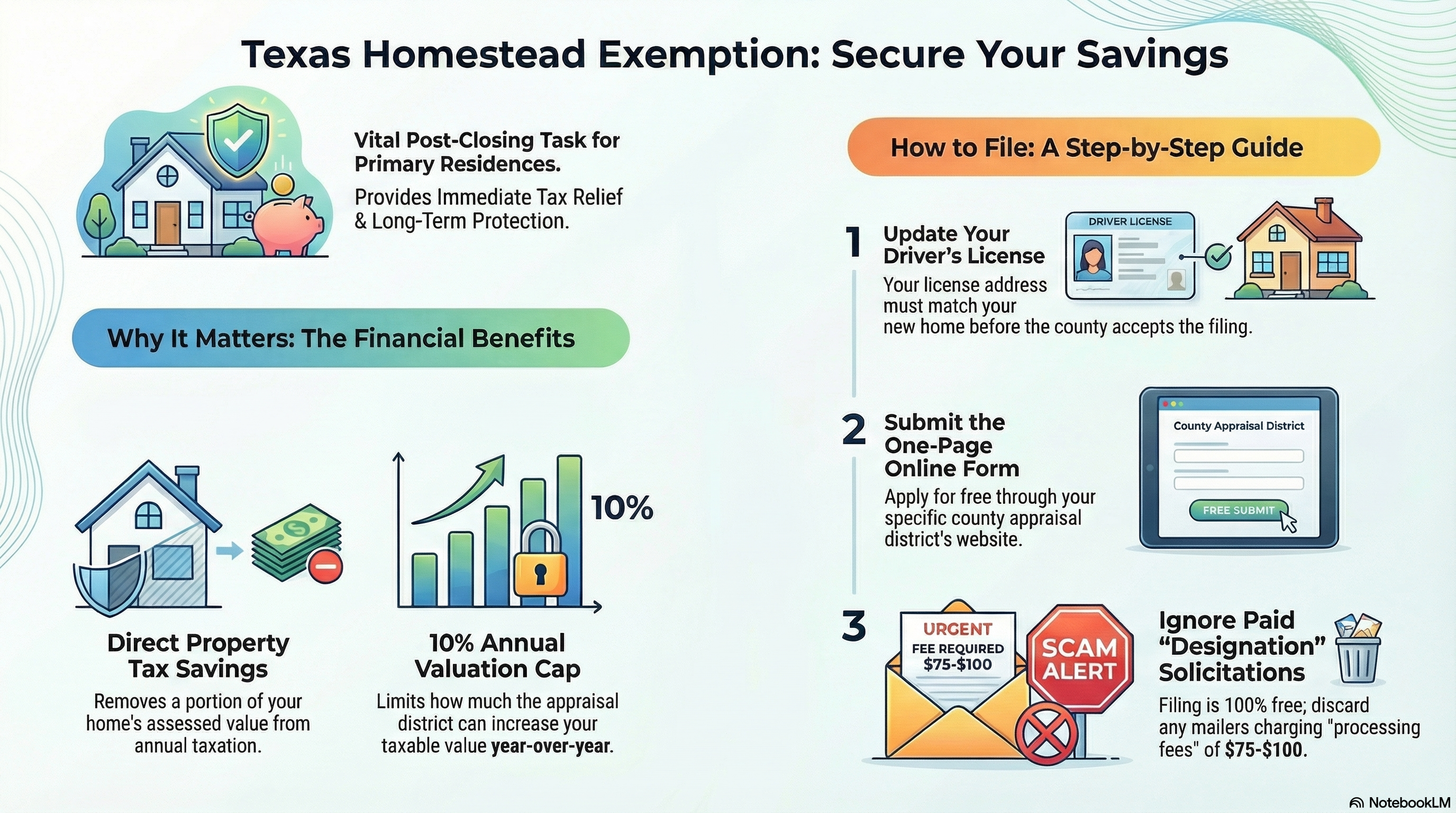
The Texas homestead exemption lowers your property tax bill by shielding part of your home's value from school district taxes. It does not change your market value; it reduces the taxable value you are taxed on. You have to file for it with your county appraisal district, and for the current tax year the standard path is Form 50-114, typically due by April 30. It applies to your primary residence only.
What the Homestead Exemption Does
The Texas homestead exemption lowers your property tax bill by shielding part of your home's value from school district taxes. It does not reduce your market value, meaning what a buyer would actually pay. It reduces the taxable value that each taxing unit is allowed to tax you on.
For the general residence homestead exemption, a set portion of your home's value is excluded from school district taxes: the exemption amount set for that tax year. The Texas Legislature sets that figure, and it can change from year to year, so check the current amount instead of assuming it stays the same. The exemption applies to your primary residence only, not to a second home or a rental.
How the Exemption Affects Your Tax Bill
Property taxes in Texas are calculated by multiplying a taxable value by local tax rates. The homestead exemption works on the value side of that equation. By removing part of your home's value from the school district's taxable base, it shaves money off the tax you pay to that district every year.
Illustrative savings on a $300,000 home
This is an illustration to show how the math works, not a quote or a promise. Your real savings depend on the exemption amount set for your tax year, the school district rate where you live, and any local exemptions. Multiply the excluded value by your school tax rate to estimate your own number.
Illustrative only. The $100,000 figure and the 1.2% rate are example numbers you might not see in your own county. Check the exemption amount set for your tax year and your county's actual school tax rate for your real figure.
How to File for the Homestead Exemption
Filing is free and takes about ten minutes. The real step is actually doing it.
Steps to file
- 1Confirm it is your primary residence. You need to own it and occupy it as your home on January 1 of the tax year.
- 2Get the application, Form 50-114, from the Texas Comptroller's website or from your county appraisal district.
- 3Complete the form and file it with your county appraisal district, online, by mail, or in person.
- 4Keep your proof of ownership and occupancy ready. The district may ask for your deed and a form of ID showing the address.
File by April 30 for the current tax year. If you miss it, late filings are typically accepted for up to two years back, so a missed deadline is usually not the end of it.
File Early, Then Set It and Forget It
The homestead exemption is not automatic. You apply once with your county appraisal district and, for most homeowners, the exemption then rolls forward year after year. But you have to actually file it that first time.
Buyers who close before the April 30 deadline should file as soon as they own the home so it can apply to the current tax year. Buyers who close after April 30 typically file for the following tax year instead.
Patriot Pro Tip
Set a calendar reminder for the week you close and file your homestead exemption right away. It is free, it takes about ten minutes, and it starts saving you money every single year. The owners who skip it usually just never got around to it, and they pay more than they should because of it.
Reality Bites: Local Rules Change Your Savings
The general state exemption is only the starting line.
Reality Bites
Counties, cities, and special districts can add their own local exemptions on top of the general state exemption. That means actual savings look different depending on where you live in Bexar County. One address can benefit more, another less, based entirely on local rules. Check with your county appraisal district for what applies at your address.
A Warning Before You Rely on These Numbers
The rules are straightforward, but they are not frozen in place.
The homestead exemption is about what you owe, not what your home is worth. If you believe your home was assessed too high and you want to fight the number itself, disputing the assessed value is a separate step from the exemption. Here is how a property tax protest works.
A Word of Caution
The dollar amount of the exemption and the filing deadlines can change from year to year. Confirm the current figure and your county's deadline before you file. This page is general information, not tax advice. When in doubt, talk to your county appraisal district or a qualified tax professional.
One More Thing: Where You Buy Matters
A home's property-tax picture is only one part of the decision.
The exemption follows you to your primary residence, but the neighborhood you choose shapes the schools, the commute, and a lot of your day to day. Thinking through where to buy in San Antonio?
Ask Patrick about the Texas homestead exemption
Get a straight answer on how the homestead exemption lowers your property taxes and how to file.