

Veterans already have the strongest mortgage deal in the country, a VA loan with zero down payment and no monthly mortgage insurance. So why would a VA buyer care about down payment assistance at all? Because zero down is not zero cash. VA buyers still face appraisal fees, title work, recording, prepaids, and lender costs, and that is the money DPA can cover. Here is how the pairing actually works for the loan program, who qualifies, and when it is worth setting up.
Quick Answer
Yes, Texas DPA programs can pair with a VA first mortgage when the program allows VA financing. Because VA already offers zero down, the assistance's main job here is the closing costs, not the down payment. The DPA credit gate and income cap still apply, and the funding fee plus the second-lien payment both land in the total obligation.
Get help lowering your cash to close with DPA on a VA loan.
The reality: VA's zero down means DPA's job is closing costs
The VA loan program is a federal benefit for eligible service members and veterans: zero down on a qualifying purchase, no private mortgage insurance, and terms civilians cannot touch. That changes what down payment assistance is for. There is no down payment for DPA to cover, so the money turns to the costs that still show up in cash at closing: appraisal, title, recording, prepaid taxes and insurance, and lender fees.
Dollar impact: the savings target shrinks accordingly. On a VA purchase, the assistance worth covering is the closing-cost stack rather than a down payment, and even a few thousand dollars of assistance can be the difference between bringing cash to the table and closing on time. VA eligibility, entitlement, and lender requirements still apply to the loan itself; the page covers the loan program only.
Eligibility: VA rules plus the DPA gate
Two sets of rules stack. First the VA side: the borrower needs VA eligibility and entitlement, usually proven with a Certificate of Eligibility, the home has to be their primary residence, and the file has to meet VA and lender standards for credit, income, and the property under VA guidelines.
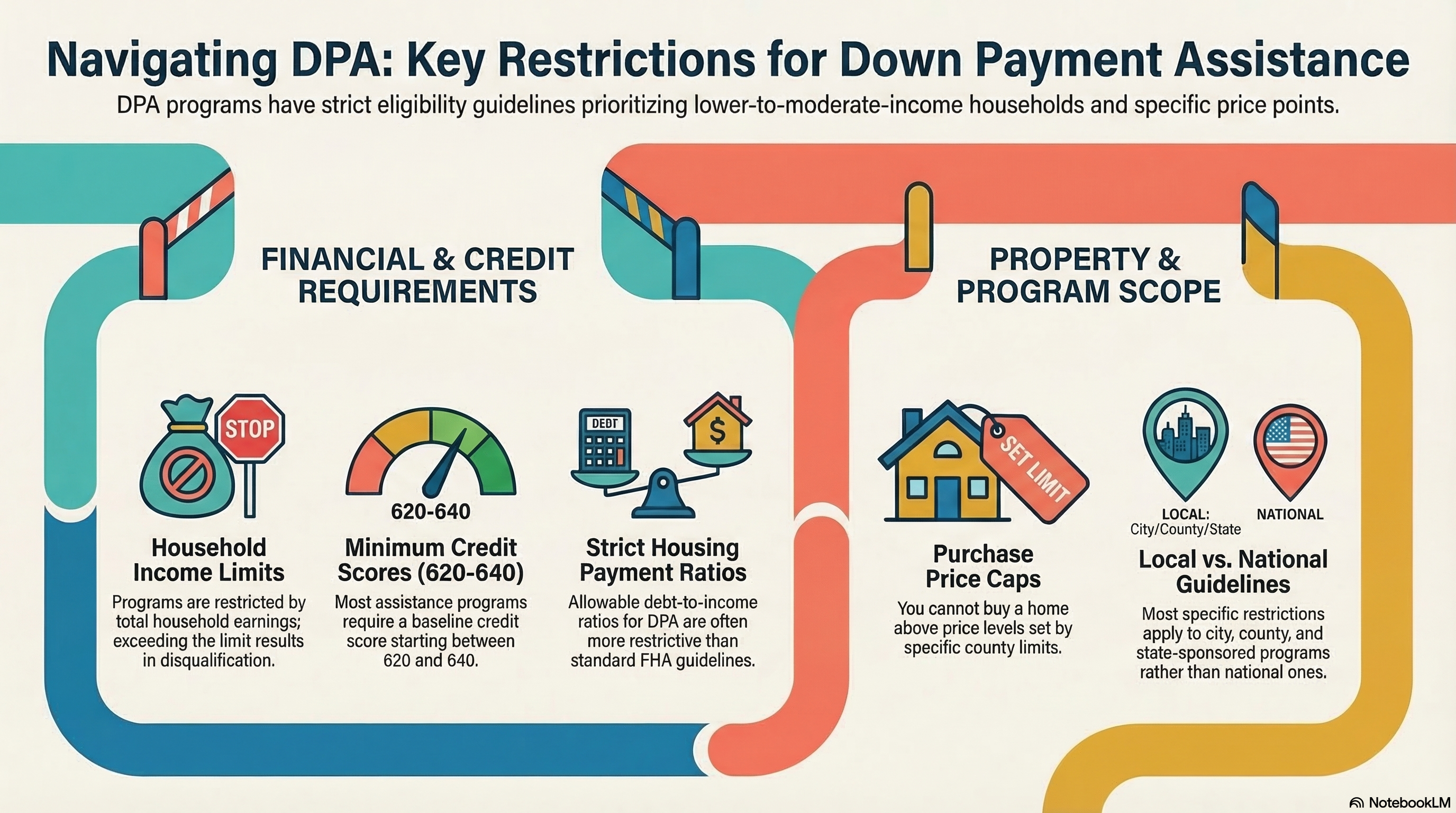
Then the DPA side: the program has to allow VA as an eligible loan type, which the major Texas programs list, and the buyer still clears the program's own gate, commonly credit around 640 and an income cap measured against the county area median income. VA financing does not waive the assistance's rules; it only sits underneath them.
What to watch: the funding fee and the second-lien payment
Two costs ride along that a VA buyer should plan for. The VA funding fee is a one-time fee on the loan, financed into the loan under VA rules unless the borrower qualifies for an exemption, and it lands in the total obligation the borrower carries. The DPA second lien can add its own payment, commonly around $80 a month on a typical small lien, and that payment counts with everything else.
The structural check matters too: the DPA program has to permit VA financing in the first place, and the second lien has to sit cleanly behind the VA first mortgage on lender terms. VA is a powerful loan program, and the honest test for DPA on top of it is the same test for any assistance: does the all-in monthly obligation still beat the file without it?
When it makes sense
DPA on a VA loan makes sense for the veteran who wants out-of-pocket closing costs minimized, which is most of them. VA's zero down already gets most eligible buyers there, so the assistance is the extra step, and the buyer should still compare the assisted file against the plain VA file dollar for dollar.
The plain-language bottom line: VA is about the loan program, and the loan program already does the heavy lifting on cash. DPA finishes the job on the edges. Run both versions on paper, include the funding fee either way, and keep the version that leaves the most cash in the veteran's pocket.
Ask Patrick about DPA with a VA loan
Find out how to use down payment assistance with a VA loan to cover closing costs.
