
Quick Answer
Prepaids are the money you pay at closing for costs that are coming due soon: a prorated slice of property taxes, homeowners insurance, prepaid interest, and the initial funding of an escrow account. Your lender collects that money up front so the bills are paid on time and the home stays fully covered. They are a normal part of your cash-to-close, not a fee, and not money you lose.
Prepaids are the upfront amounts you pay at closing for costs that are coming due soon: a prorated slice of your property taxes, your homeowners insurance premium, a little prepaid mortgage interest, and the initial funding of your escrow account. They are not fees the lender pockets. They are money set aside so the taxes and insurance on your new home are covered without a gap from the very first day. If you are staring at prepaid line items on your closing costs and wondering whether you are being overcharged, this page pulls back the curtain.
Prepaids vs Closing Fees: Two Very Different Things
This is the confusion that trips up most first-time buyers, and it is a fair one because both appear on the same statement. Lender fees and title fees pay for services: the work of originating your loan, underwriting your file, searching the title, and closing the deal. Those are the costs of making the purchase happen. Prepaids are not a service. They are money set aside to cover bills that are coming due, like property taxes and homeowners insurance, plus the interest that accrues between your closing date and your first mortgage payment.
A quick way to tell them apart: a fee pays somebody for doing something, and a prepaid pays a bill that would need to be paid anyway. If a line says "origination" or "title insurance," that is a fee for a service. If a line says "property taxes," "homeowners insurance," or "prepaid interest," that is a prepaid heading to a bill in your name. For the full tour of every bucket on a buyer's cost statement, read my answer on buyer closing costs in Texas. And to keep your two big pots straight from the start, this walkthrough of down payment versus closing costs is worth reading before you tour a single home.
Prepaids vs Fees at a Glance
PATRICK TEACHING: the same statement, two different kinds of line items.
| Kind of line | What it pays for | Where the money goes |
|---|---|---|
| Closing fee | A service: origination, underwriting, title, recording | The lender, title company, or county |
| Prepaid | An upcoming bill: taxes, insurance, interest | Your escrow account or the payee on your behalf |
| Initial escrow funding | A cushion of future taxes and insurance | Your escrow account, held for your bills |
The Big Prepaids: Taxes and Insurance
In my Essential First-Time Homebuyer Roadmap, escrow and the initial funding are one of the sections I make sure every buyer reads twice, because this is where the biggest prepaids live. At closing you typically do two things at once: you pre-pay the portion of your taxes and insurance that covers your ownership window, and you fund the escrow account that will pay the first insurance premium and the tax bills when they come due.
- Property taxes: Texas tax bills are usually due in large chunks once or twice a year. If you close mid-cycle, you pay the slice of the annual bill that covers the days you own the home, so the county is never left waiting on what is already owed.
- Homeowners insurance: Your insurance policy has to be active the day your loan funds and usually the first year's premium is paid at or around closing, either directly or through escrow. No insurance, no closing.
- Prepaid interest: Mortgage interest is paid in arrears, so you cover the interest from your closing date through the end of that first month. The bigger the loan and the later in the month you close, the larger this line.
- Initial escrow funding: Your lender collects a few months of future taxes and insurance up front so the account never dips below what is needed when a bill lands. This is the cushion that keeps everything on time.
That escrow account is the same one that lives inside your monthly mortgage payment after closing. If you want the full picture of how the account works and what it does with your money, my answer on escrow accounts at closing walks through it, and this breakdown of what is actually in your monthly mortgage payment shows where the escrow portion goes every month.
Why They Are Collected Up Front
The Why-Upfront Block
Your lender has a very practical reason for collecting prepaids at closing: the house itself is the collateral for your loan, and an uninsured house with unpaid taxes is a house at risk. By funding escrow up front, the lender can keep your taxes and insurance current from day one, no waiting, no gaps, no surprise lapse in coverage. The exact same money keeps flowing through escrow each month after you move in, so the system you start at closing is the system that protects the home for as long as you hold the loan.
It is not the lender being greedy with your cash. It is the lender making sure the two biggest obligations tied to the property get paid. If you have ever wondered why your mortgage bill includes dollars that are not interest and principal, my answer to why your mortgage company collects taxes and insurance every month explains the whole loop.
Where They Show Up on Your Paperwork
Prepaids appear as their own line items on your Closing Disclosure, in the sections labeled prepaids and initial escrow at closing. Once you see the lines, the mystery evaporates. Here is a plain-English translation of what you are actually paying for:
What You're Actually Paying For
TYPICAL RANGE / education only. Your exact lines and amounts come from your Loan Estimate and Closing Disclosure.
| Line item | What it is | Why it sits at closing |
|---|---|---|
| Property taxes | Your prorated share of the annual tax bill | The county collects in large chunks, so you pay your slice at closing |
| Homeowners insurance | Your premium, typically the first year or the escrowed portion | The policy must be active before your loan funds |
| Initial escrow funding | A cushion of future taxes and insurance | Keeps the account ahead of the next bill |
| Prepaid interest | Interest from closing day to the end of the month | First payment comes later, so you pre-pay month one's tail |
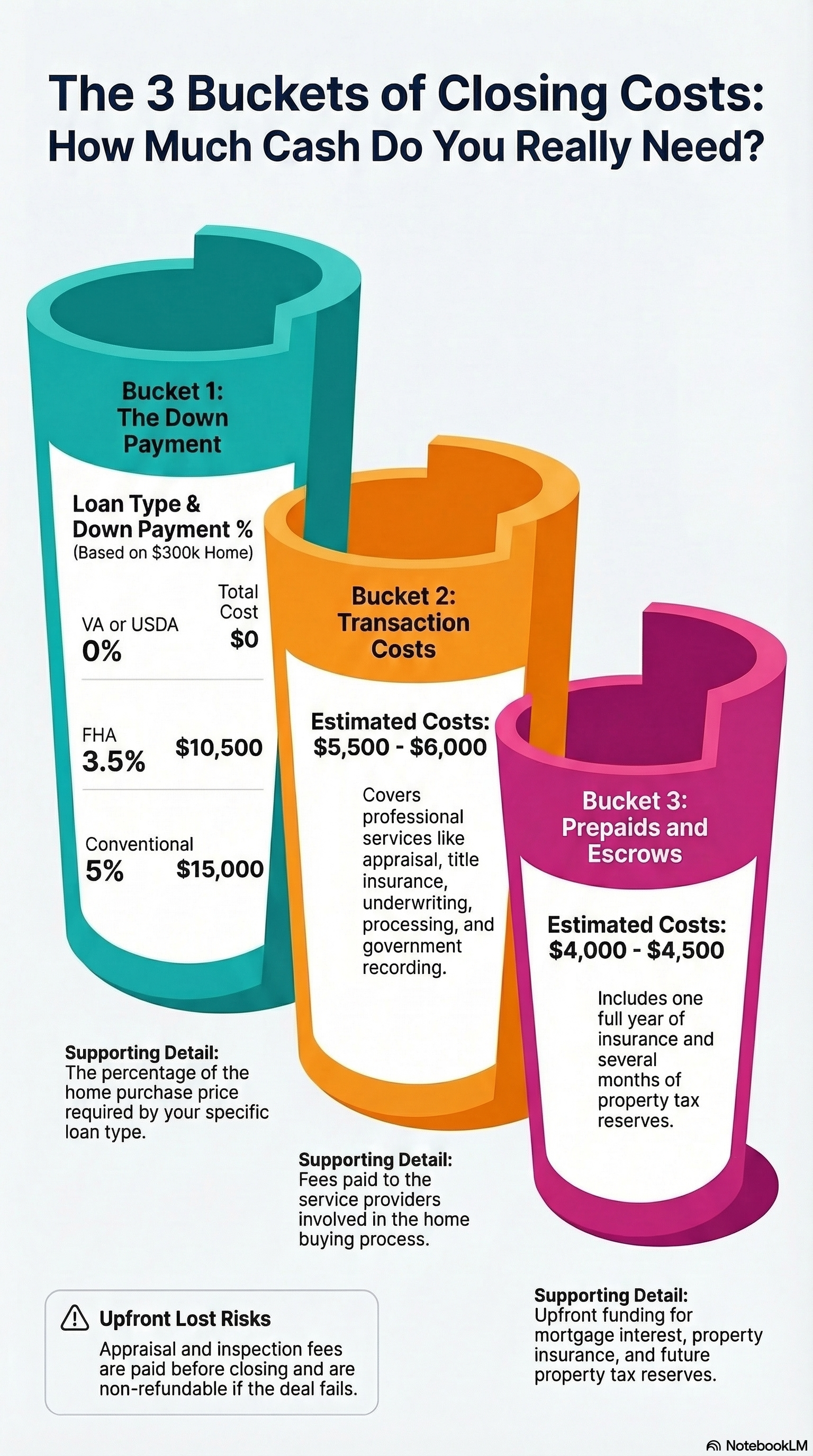
The Closing Disclosure is the last official look at every line before you sign, and knowing where to look is half the battle. My guide to the Closing Disclosure, explained in plain English, shows you exactly how to check your prepaids against what you were quoted.
How Much to Expect: The Method, Not the Guess
Here is the honest answer: nobody can give you a reliable prepaid number from an article, because prepaids are built from your specific property and your specific timing. Three inputs drive the total. The property's tax bill, which comes from the county appraisal district and the exact due dates in your taxing calendar. The homeowners insurance quote, which depends on the home, its condition, and your coverage choices. And your closing date, which decides how many days of prepaid interest you owe and how much tax proration lands on your side.
ILLUSTRATIVE: These are teaching numbers to show the method, not a quote. Your real prepaids come from your loan officer, built from your property's tax figures, your insurance quote, and your closing date.
Illustrative Example: A Mid-Year Closing
Shown to demonstrate how prepaids stack, not what your closing will cost.
| Prepaid component | How it is figured | Illustrative size |
|---|---|---|
| Property tax proration | Daily tax rate times your days of ownership this cycle | A few months of taxes, varies by district |
| Homeowners insurance | Your quoted annual premium | First year's premium or the escrowed portion |
| Initial escrow funding | Months of cushion required by your loan program | Roughly two to a few months of taxes and insurance |
| Prepaid interest | Daily interest times days left in the month | Depends on loan size, rate, and closing date |
The fastest way to a real number is a conversation with your loan officer, who pulls the actual tax certificate and insurance quote for the home you are buying and runs the math against your closing date. If you are building your overall cash plan right now, my answer on how much cash to plan for when buying your first home folds prepaids into the full picture alongside your down payment and closing fees.
They Are Not a Loss, They Are Coverage
I understand why prepaids feel like money walking out the door. You have not lived in the house for a day, and the statement asks you to pay a year of insurance and a slice of taxes before the boxes are even unpacked. Here is the reframe: you are pre-paying bills you would owe anyway. The insurance premium protects your family's biggest asset. The taxes keep the county satisfied on the property you now own. The interest covers the days between your closing and your first payment. None of it is a fee, and none of it disappears into the lender's pocket.
It also comes back around. Your escrow account is reviewed regularly, and when the balance runs ahead of what your bills need, the surplus is reconciled and refunded to you. That annual review is called an escrow analysis, and my answer on what an escrow analysis is and why your payment might change explains why the number can move from year to year. The short version: prepaids start a system, and the system keeps your money working for your own bills.
Sincerely,
Patrick Kevin Fagan
Patrick's Take
"Prepaids aren't the lender keeping your money. It's you fronting the taxes and insurance so the bills are covered on day one. Know them, plan for them, don't fear them." Ask Patrick about prepaids.
Quick FAQ on Prepaids
Are prepaids a fee?
No. A fee pays someone for a service, like origination or title work. A prepaid pays an upcoming bill, like taxes, insurance, or interest. Your lender does not profit from prepaids; the money is set aside for bills in your name.
Do I get prepaids back?
You do not get them back at closing, because they go straight to your bills and your escrow cushion. But when bills are paid from escrow, you are spending what was already collected. Later, if you sell or refinance, the escrow account is reconciled and any surplus is refunded to you.
What is the difference between prepaids and closing costs?
Closing costs is the umbrella term for everything you pay to make the purchase official: lender fees, title fees, recording fees, and prepaids. Prepaids are the slice of closing costs that covers your upcoming taxes, insurance, and interest instead of paying for a service. My guide to buyer closing costs in Texas shows how the buckets fit together.
How do I estimate my prepaids?
Ask your loan officer to run an itemized estimate built from three inputs: the property's tax bill and due dates, your homeowners insurance quote, and your planned closing date. The Loan Estimate shows your prepaids early, and the Closing Disclosure locks in the final numbers before you sign.
Want Your Real Prepaid Numbers, Not a Guess?
As a loan officer and Realtor, I walk every buyer through the prepaid line items before anything is signed. Bring me your property and your closing date and I will show you what your cash-to-close really looks like, no surprises at the table.
Ask Patrick about prepaids
Get a straight answer on prepaids, taxes, insurance, and planning for them.