

Quick Answer
Your opening offer should be grounded in what comparable homes have actually sold for, then adjusted for the market you are in. There is no single right number, but there is a right way to build one: start with the comps, read whether it is a seller, balanced, or buyer market, and decide honestly how much you want that specific home. This page gives you the framework, step by step.
Most first-time buyers who call me ask, "How much should I offer?" and hope for one clean number. There isn't one, because the right number depends on the comparable sales nearby, the current market conditions, the condition of the house, and how badly you want it. Ask Patrick how much to offer on a home.
What I want you to take away is this: a smart offer is built on evidence, never pulled out of thin air, and the price is only one piece of the package. My job is to make sure you feel coached and capable before you put your best offer in writing.
Your Offer Is a Package, Not Just a Price
In every deal I have coached, the price was the headline, but it was almost never the thing that decided the winner. Terms, timeline, contingencies, and concessions are the rest of the package, and they do most of the heavy lifting. That is why I always tell first-time buyers to negotiate the whole offer, not just the number.
The Levers Inside a Winning Offer
Price
The headline, grounded in comparable sales, not a guess.
Closing date
A faster close can beat a higher number, especially with sellers who need to move.
Contingencies
Which protections stay and which you are willing to trim to be more competitive.
Seller concessions
Asking the seller to contribute toward your closing costs can lower your cash to close.
Anchor Your Number in Comps (Never Pull One Out of Thin Air)
Comps are comparable sales, the homes near the one you want that have actually sold and closed, not the ones still listed. They are the honest foundation for your number because they tell you what buyers have been willing to pay. Then you adjust that starting point for three things: current market conditions, the condition of this home compared with the comps, and how much you want the home. Together they give you a defensible floor and ceiling, so your offer has a reason behind it whether you are above list or below it.
Before you worry about the offer number, make sure you can actually afford the range you are working in. Here is how to figure out how much house you can afford, so you set your floor and ceiling before a single offer is written.
How to Anchor Your Number
- 1Pull the comparable sales: homes of similar size, age, and layout that sold within the last few months.
- 2Adjust for condition: a renovated, updated home deserves more than a dated one, and a fixer deserves less.
- 3Read the current market conditions to decide whether you lean toward the floor or the ceiling.
- 4Set your walk-away number before you write anything, so a counter never talks you into a deal you regret.
CURRENT VERIFIED: comps are the sold and closed homes nearby, not the asking prices still on the market.
A Market-Based Pricing Framework
The same house can call for a completely different offer depending on which market you are in. Here is the framework I use with every buyer, and it is the same logic I lay out in The Essential First-Time Homebuyer Roadmap. None of these are hard rules, they are typical market practice, and your specific comps always get the final word.
Three Markets, Three Strategies
| Seller's Market | Balanced Market | Buyer's Market | |
|---|---|---|---|
| Starting offer | At or above list price | 2-5% off list if comps support it | 5-8% below list depending on DOM and price cuts |
| Contingencies | Minimize them to stay competitive | Standard contingencies are fine | You can keep most protections |
| Concessions | Rarely ask, sellers rarely give | A 2-3% concession ask is reasonable | Concessions are very negotiable |
| Mindset | Lead with your strongest offer, there may not be a round two | Leave room for one clean round of negotiation | Compete on terms but do not be offensive |
TYPICAL MARKET PRACTICE as of August 2026. Your local comps and days on market always refine these ranges.
Days on Market Is Your Cheat Code
Let me teach you one of the most useful signals in pricing: days on market, or DOM. If homes in your area are averaging 12 days on the market and the house you love has sat for 84, somebody has swiped left on it, and I need you to find out why before you write an offer. Long DOM can mean price cuts, deferred maintenance, a tricky layout, or a bad location. It can also mean the seller is getting anxious, which is leverage that belongs to you.
Patriot Pro Tip
Use DOM as an honest negotiating signal. A house that has been on the market for months is not a house you need to offer full price on, but it is also not a house you should lowball without understanding why it is still there. Ask the right questions first, then let the number reflect what you learned.
The Fine Line Between a Smart Low Offer and an Insulting One
There is a real difference between a smart low offer and a lowball, and knowing it keeps you persuasive instead of offensive. A smart low offer is backed by solid comps, respectfully presented, with a reason attached. That is a negotiation opener, the seller will likely counter, and now you are in a conversation. A lowball with no justification is a relationship-ender. It tells the seller you are not serious and can get your offer ignored entirely.
The Line in Practice
You want the seller annoyed enough to counter, not offended enough to trash your offer. If you want to open low, bring proof, show respect, and leave the door open to move. A justified, polite number gets responded to. An unexplained shock gets deleted.
Earnest Money: How Much Is Enough?
Earnest money is the deposit that shows the seller you are serious, and the standard is about 1% of the purchase price. On a $350,000 home, that is about $3,500. In a competitive market, going to 2-3% can make your offer stand out among similar ones. Here is the part buyers love to hear: earnest money is not an extra cost. It is held in escrow and credited toward your down payment and closing costs at closing, so it becomes part of the money you were already going to bring.
One caution I give every buyer: more skin in the game means more to lose. Here is a full walkthrough on earnest money amounts in Texas, and I usually advise staying around 1% unless you are sure the stronger deposit is worth the risk.
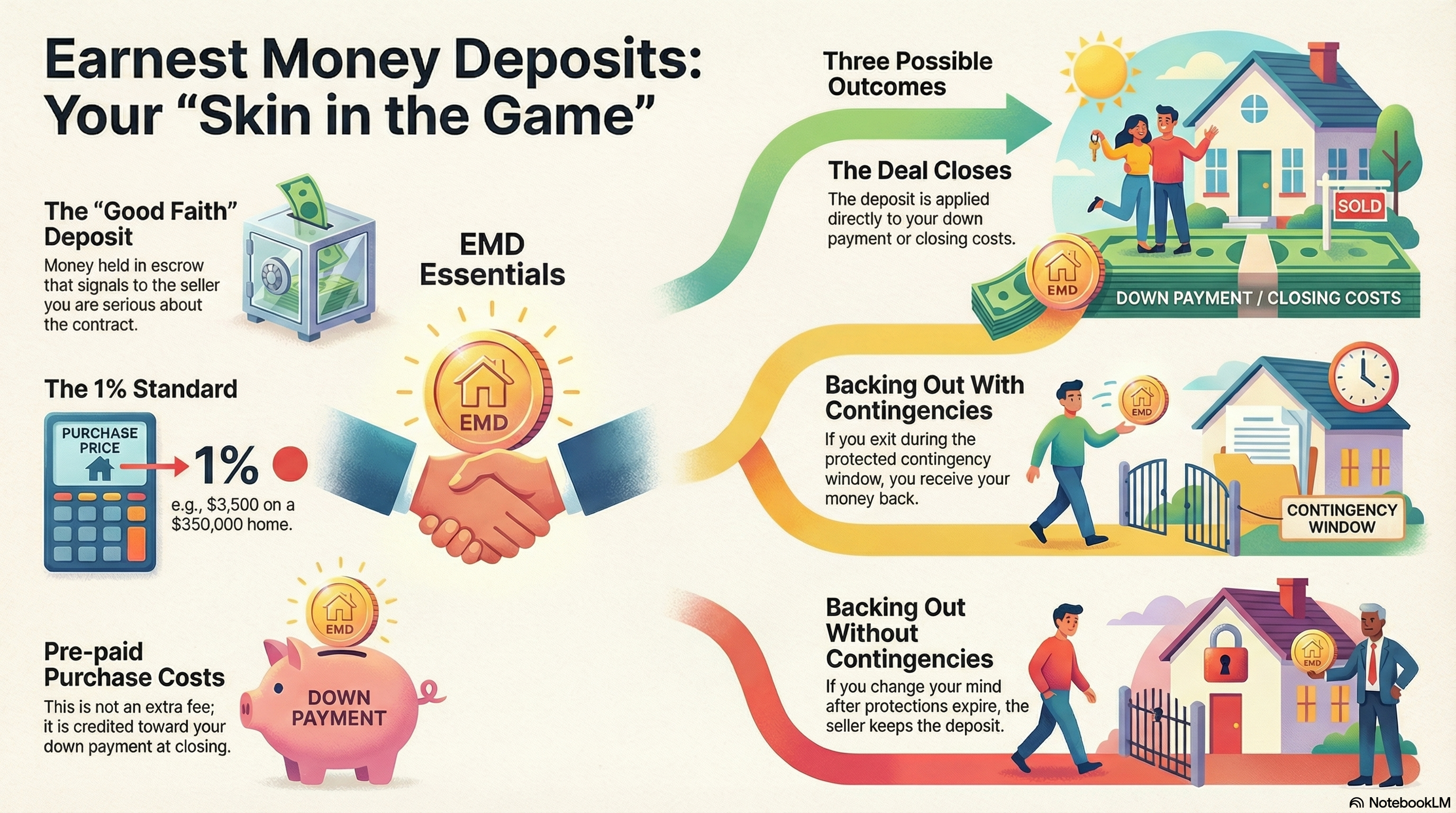
Worked Example: A $350,000 Home
Here is the standard deposit range in real numbers, and what each level signals.
Every one of these is credited back to you at closing, so none of it is a fee on top of the price. But remember, the more you commit, the more you have on the line if the deal falls apart.
What to Negotiate Besides the Price
Because the offer is a package, the price is just one of many levers, and sometimes it is not even the most important one. I have won deals with a faster closing date against higher offers, and the book is full of that exact lesson. Here is the short list of everything on the table beyond the number.
Beyond the Price: Levers You Can Pull
| Lever | What to ask for |
|---|---|
| Closing date | Speed wins. A 21-day close has beaten higher prices, so a shorter timeline can be your strongest card. |
| Seller concessions | A credit toward your closing costs lowers your cash to close and can beat a simple price reduction. |
| Inclusions / exclusions | Which fixtures, appliances, and extras stay with the home and which go with the seller. |
| Repairs | The items to fix or credit back after the inspection report comes in. |
| Home warranty | Ask the seller to fund a home warranty to cover major systems after closing. |
| Option period | A longer window to inspect and walk away, and the fee that buys that right. |
Seller concessions are a favorite of mine because they shrink the cash you actually have to bring to closing. Here is how seller concessions work in Texas.
For the full walkthrough of every lever beyond the number, here is what you can negotiate when buying a house besides price, from repairs and earnest money to the option period and the home warranty.
The Counter-Offer Dance
Very few first offers get accepted as-is, and that is completely normal. Most deals resolve in one to three rounds of back and forth. Your main goal in every round is simply to get under contract, because once you are under contract, there are still chances to renegotiate on inspection and other addenda. Do not let the dance panic you, and do not fall into lazy habits.
Worked Example: $380K Offer vs $400K Counter
The lazy move is to split the difference and land on $390,000. The smart move is to move a little and justify it.
Do not just land on $390,000. Counter with $384,000 and back it with evidence: "Based on comparable sales and the condition of the home, our offer at $384,000 is well supported." Justification makes a modest move feel principled, and changing other terms shows you are negotiating in good faith, not just the number.
Three habits carry you through the dance: know your walk-away number before you start, change more than just the price, and always counter with a reason tied to comparable sales. Here is a deeper guide to writing a competitive offer.
Walk Through Your Offer Before You Write It
Here is the short flow I run with every first-time buyer so the whole package, not just the number, comes together in the right order. Run your situation through it and you will walk into your offer feeling coached instead of guessing.
Your Offer Flow
- 1Read the market and anchor in comps.
- 2Set your walk-away number before you write.
- 3Structure the whole package, not just the price.
- 4Counter with justification and change more than the price.
- 5Keep your eye on the goal: get under contract.
When to Waive Contingencies (and When Never To)
Contingencies are the protections that let you walk away without losing your earnest money, and the three essential ones are inspection, appraisal, and financing. In a hot seller's market, sellers love a clean offer, which is why some buyers waive or shorten these. But there is one line I will not let a client cross: never waive the inspection. A seller who wants you to skip the inspection is a seller who does not want you to find the problems.
The Three to Protect
Inspection
Never waive this. It is your protection against expensive surprises hiding in the walls.
Appraisal
Protects you if the home appraises for less than your offer, so you are not overpaying.
Financing
Protects your deposit if your loan does not come through as planned.
A cleaner, faster way to compete is to do a pre-inspection before you write your offer, so you can shorten the inspection contingency from a position of knowledge. Here is more on when it makes sense to waive contingencies in a bidding war.
If You Really Like the Home, Get the Home
This is twenty years of closing advice in one sentence: if you genuinely want the home, do not lose it over a few thousand dollars because you are holding out for a number in your head. I have watched deals die over pride, and it never feels worth it afterward.
Super Patriot Pro Tip
I once had a borrower whose agent talked him into a lowball in a market where he should have just bought the house. He lost the home over what worked out to roughly $45 a month. PATRICK OPINION: That lost home cost him weeks of searching and far more in stress than the small monthly difference ever would have. PATRICK HISTORICAL / ILLUSTRATIVE story, but the lesson is real every single day: pride is the most expensive counter you can make.
Quick Answers to Your Follow-Up Questions
These are the next questions buyers ask me as soon as they start thinking about their number. Here is the short version of each.
How much below asking price should I offer?
There is no flat rule, because it depends on the market. In a buyer's market with homes sitting, an offer 5-8% below list can be reasonable. In a balanced market, 2-5% off is typical when comps support it. In a seller's market, your offer often needs to be at or above list to compete. The honest answer always comes back to your comps and the days on market.
Does a low offer offend the seller?
It can, if it has no justification. A low offer that is backed by comparable sales and respectfully explained is a normal negotiation opener, and sellers respond to it. A lowball with no proof behind it reads as disrespect and can end the conversation. Bring the evidence, be polite, and you will almost always get a counter instead of a silence.
How much earnest money should I put down?
About 1% of the purchase price is the standard, about $3,500 on a $350,000 home. In a competitive market, 2-3% can help your offer stand out. Just remember it is money on the line, even though it is credited back to you at closing, so usually do not go above 1% unless you are sure a stronger deposit is worth it.
Can I negotiate closing costs in the offer?
Yes, and you should. Asking the seller for a concession toward your closing costs is one of the smartest levers in the offer, because it directly lowers the cash you bring to closing. A concession request is common in balanced and buyer's markets. Learn which closing costs you can ask a seller to cover, and what buyers typically pay in Texas, so your concession ask is realistic and well supported.
Ask Patrick about how much to offer
Get a straight answer on pricing an offer in today's San Antonio market.