

Every year you own a rental, depreciation quietly lowers your taxable income, and most owners take it at the slowest possible speed. Cost segregation is the move that front-loads those deductions, and for the right property it can be worth a meaningful amount of cash in the early years.
Quick Answer
Cost segregation accelerates depreciation by splitting a building into components that write off faster than 27.5 years, cutting taxable income early. It pays most on larger deals, so run the math before commissioning a study.
Ask Patrick how cost segregation on rentals would work for your investment goals.
What Cost Segregation Is
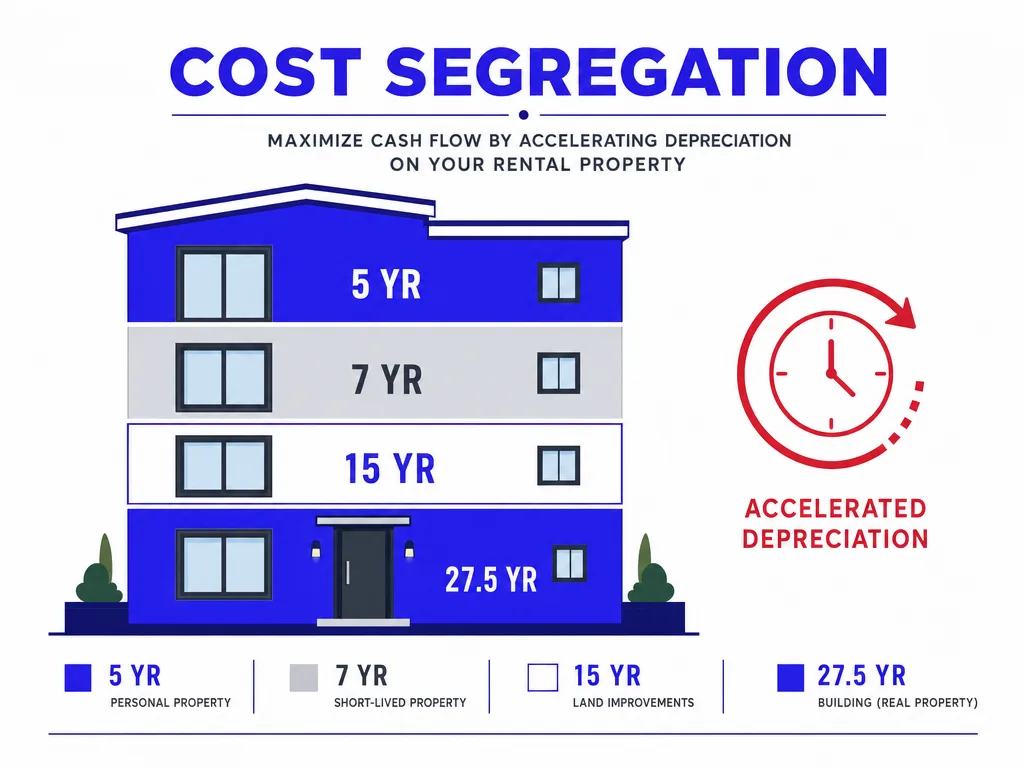
Here is the term: cost segregation. A residential rental building normally depreciates over 27.5 years, which spreads the deduction thin and slow. A cost segregation study takes that one big number and splits it apart, reclassifying parts of the building into faster IRS depreciation schedules.
Interior finishes, wiring, plumbing, lighting, and land improvements can fall into classes as short as 5, 7, or 15 years. The result is more depreciation taken in the early years of ownership, which lowers taxable rental income when your deductions matter most.
How It Works
A qualified firm studies the property, documents each component, and assigns it to the right depreciation class under IRS method. The IRS describes these accelerated classes in its depreciation guidance and audits cost segregation studies closely, so the work must follow the method and be well documented.
The strategy is legitimate when the classifications match the actual property and the paper trail is complete. It is not an accounting trick, it is a timing decision, and the paperwork has to be right from day one because the IRS will look closely at it.
Who It Makes Sense For
Newer purchases, larger properties, and investors with a long hold period gain the most. Older deals and short hold plans rarely justify the study cost, and a quick break-even estimate settles it before you commission anything.
On a smaller San Antonio rental, the study fee can eat the first-year savings, so I run the rough math before anyone spends a dollar on engineering. Size up the property, check your hold plan, and only then decide whether the front-loaded deductions are worth the fee.
The Cost and the Break-Even
A cost segregation study is professional work, and it is priced like it: typically in the thousands, and on many properties the study fee runs $5,000 to $15,000 depending on the size and complexity of the building.
The question is break-even, not whether the strategy is good. Compare the fee against the tax savings you will actually capture in the first few years. If the study pays for itself quickly and you plan to hold, it is a strong move. If the savings crawl, the fee is just a bill.
The Recapture Catch
Accelerated depreciation is not free money. Those deductions can create depreciation recapture when you sell, and the benefit is timing, not elimination. You move the deduction earlier, you do not erase the tax.
For a long-term holder the timing advantage is usually worth it, because money saved now is worth more than money saved later. Just know going in that a faster deduction now can mean a larger tax line at the sale. Plan the exit the same way you plan the purchase.
Do It With the Right Team
Use an experienced cost segregation firm and your CPA together, keep the engineering report with the tax files, and expect the IRS to look closely. The strategy is legitimate when the classifications match the actual property and the paper trail is complete.
Pair the study with a tax professional who understands Texas rental reporting, because the paperwork has to be right from day one. Run the break-even first, size the property honestly, and make it a great one.
Ask Patrick about cost segregation on rentals
Get a straight answer on cost segregation on rentals and how it fits your rental or investment plan.
