

Somebody hands you a rental that pencils out great, and then you find out the cap rate was built on rent that the property has never actually collected. That is the money problem with this metric: the formula is easy, and the inputs are where deals live or die.
Quick Answer
Cap rate is annual net operating income divided by purchase price, a return before financing. Use it to compare similar deals, not as a standalone verdict, and pair it with cash-on-cash return for the real picture.
Ask Patrick how cap rate math on rentals would work for your investment goals.
The Formula in Plain English
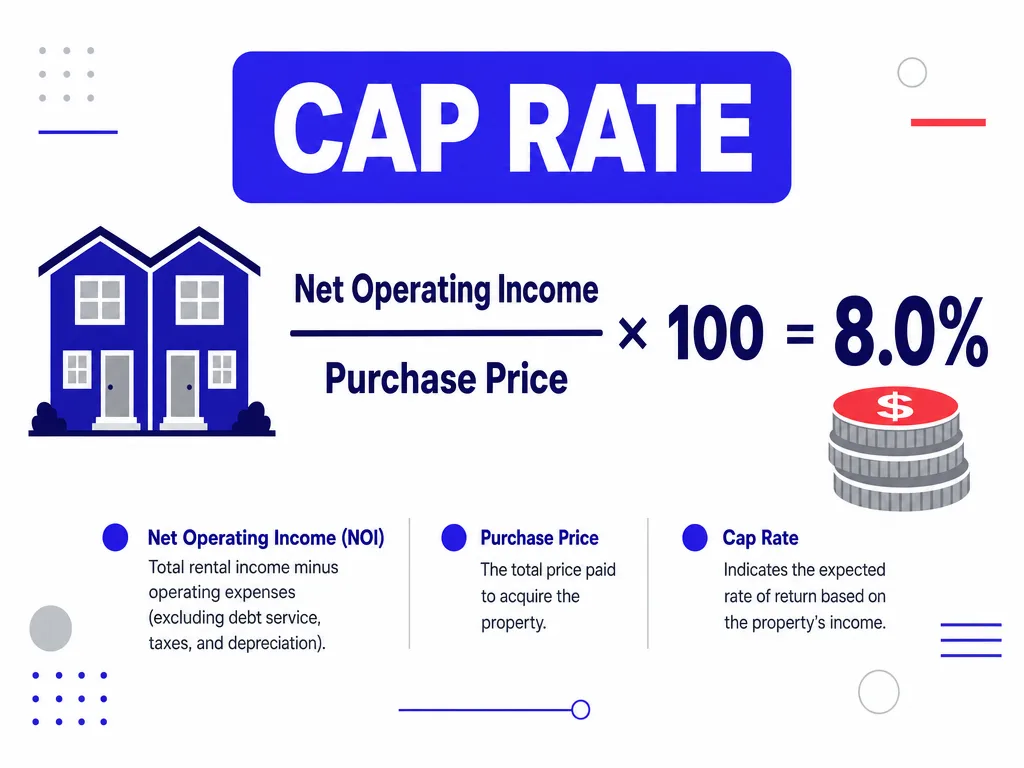
Here is the term: cap rate, short for capitalization rate. The formula is Cap Rate equals annual net operating income divided by the purchase price, then times 100 for a percentage. It answers one question: if you bought this rental for cash and paid every operating cost, what percentage return would the income produce?
Notice the word cash. The cap rate assumes no mortgage at all, which is exactly what makes it a clean comparison tool and exactly what makes it incomplete for your decision. It measures the property, not your financing.
The Work Is in the Inputs
Net operating income, or NOI, is gross rent minus operating expenses: property taxes, insurance, maintenance, vacancy, and property management. None of it includes the mortgage. Every one of those lines is an estimate, and each one is a place where a deal gets inflated.
If the taxes, insurance, maintenance, vacancy, and management are underestimated, the cap rate looks better than the deal really is. I build those numbers conservatively before quoting a yield, because an honest cap rate starts with honest expenses.
What a Higher Cap Rate Tells You
Cap rates matter most as a comparison tool: two similar duplexes in the same submarket, and the one with the higher cap rate is earning more before financing, all else equal. That is the signal you want when you are deciding between two deals.
But a higher cap rate can also signal more risk or a less desirable area, and a very low cap rate can mean an overpriced asset in a hot neighborhood. The number does not tell you which is which on its own. It tells you to go look.
Compare Like for Like
The whole value of a cap rate is comparing similar properties in the same submarket, because location, property type, and condition drive the number more than anything the seller says. That is why I compare like-for-like, never a Bexar County duplex against a Canyon Lake lakefront.
Run every candidate with the same assumptions, the same vacancy, the same maintenance percentage, the same taxes. The instant the assumptions differ, the comparison is worthless, and that is how a bad deal hides inside a pretty spreadsheet.
San Antonio Ranges
San Antonio single-family rentals and small multifamily commonly trade in the 5 to 8 percent cap range, with newer properties and strong school zones at the lower end and older, higher-maintenance rentals at the upper end.
Market figures vary with financing and assumptions, so verify each property's actual income and costs rather than relying on advertised rates. A listed cap rate is a starting point for your own math, never a verdict.
The Two Numbers You Need Together
Cap rate compares the deal before debt; cash-on-cash return tells you what your actual down payment earns. One without the other gives a misleading picture, especially when rates and leverage change the monthly numbers.
Run both on every deal, Patriot Nation. Cap rate to compare the property fairly, cash-on-cash to see what your wallet actually earns, and the two together tell you whether the deal works for you specifically. That is the whole game, and make it a great one.
Ask Patrick about cap rate math on rentals
Get a straight answer on cap rate math on rentals and how it fits your rental or investment plan.
